I've been wanting to put up this lookbook for some time...and I would've kicked the idea to the curb if it weren't for the way you responded to the "Really Old School" lookbook and its video counterpart.
In 1992, I wrote a screenplay called "Rivertown Rock!" In it, I wanted to take a look at how music's British Invasion affected teenagers here in America's Midwest in general...and one family in particular. Always wanted to take a look at it through a screenplay of mine.
I wouldn't have started a record collection if the invasion weren't a catalyst...and maybe you began collecting 45s and albums back then, too, because of groups like the Beatles and the Dave Clark Five and the Rolling Stones.
Well, after getting feedback through Stage 32, I decided to revise that script of mine (same for "Really Old School" and two others)...and now, through sources like Network ISA, I'm looking for a producer who'd like to film it. (I've already submitted five screenplays of mine through ISA...and got yet to hear from any producers. That's okay...that's the way the system is.)
Here's the "Rivertown Rock!" logline:
It's Sunday, 2-9-1964...when the Beatles' appearance on The Ed Sullivan Show inspires a Sioux City, IA teenager to start her own rock group and show that girls can play the music, too.
I'm Jim Boston...thanks so much for reading this blog!
Showing posts with label 1964. Show all posts
Wednesday, June 17, 2020
Saturday, August 16, 2014
It All Started with These...
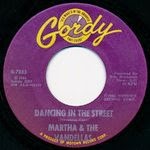
You're looking at the first two records I ever owned in my life.
The bad news is: I don't have the original 45-RPM singles anymore.
But the good news is this: I went on to find the Four Tops' "Baby I Need Your Loving" and Martha and the Vandellas' "Dancing in the Street" on albums.
It was fifty years ago this month that I started collecting records (with Dad's and Mom's financial help, of course...heck, I was eight-going-on-nine years of age!).
The real impetus for launching a personal record collection was still going some kind of strong in August 1964...six months after that impetus originally took hold here in America.
That's right...just as Elvis Presley's entry onto the Billboard pop chart in March 1956 ended up causing a boom in the record industry (and transforming everything else), so the Beatles' arrival on that same chart in January 1964 (and- the absolute clincher- their live appearance on TV's The Ed Sullivan Show on 2-9-1964) caused an even longer-lasting boom in the record business (and transformed everything else).
Started collecting records at a time when, to tell the truth, I was actually away from home...and not of my own choosing.
Where I was forced to stay, I heard the records that some of the other children at that same facility had bought and were playing. (Once a week or so, we'd go into the rec room down in the basement and stack that portable record player with 45s; once in a while, an album would get heard...and, more often than not, the LP was "Meet the Beatles!")
At that time, music was on many Americans' minds...especially the minds of the youngest citizens. If it wasn't the Fab Four, it was the Dave Clark Five or the Searchers or Gerry and the Pacemakers or Billy J. Kramer and the Dakotas or Manfred Mann or Herman's Hermits or the Animals...to say nothing of the Rolling Stones.
Or it was some of the acts those British bands learned from...like the Miracles and the Contours and the Supremes and the Temptations and Martha and the Vandellas and the Four Tops (to say nothing of Chuck Berry, who'd found his way back on Billboard's charts at that very moment).
Besides those rec-room moments, the radio was always playing (when the TV wasn't on), and it was always tuned to a Top 40 station...in this case, KWWL in Waterloo, IA. (I lived in Eastern Iowa from January 1964 to June 1967.)
And starting my own record collection helped make that three-and-a-half year period easier to take.
Me, I didn't want to stop at Motown...or at any one genre of music.
And so, the next three singles I happened upon are now the oldest surviving 45-RPM releases I own: "Come a Little Bit Closer" by Jay and the Americans, "Selfish One" by Jackie Ross, and "Michael," Trini Lopez' remake of the Highwaymen's 1961 Number One smash.
Anyway, I started buying albums in mid-1967 while continuing to purchase 45s (by then, I was receiving an allowance); over the next fifteen years, my collection grew, slowly-but-steadily.
By 1982, the cache exploded.
It was all because I found out about Kanesville Kollectibles (530 S. 4th St., Council Bluffs, IA), the biggest used record-tape-CD store in the Hawkeye State.
I got to the point where I'd go shop at Kanesville once a month. (Now I'm lucky to stop in twice or three times a year.)
Thanks to Kanesville Kollectibles and the chance to go to record shows every year since 1984, I now own roughly 2,000 records, tapes, and CDs.
And since 2007, I've been working on digitizing these records and tapes, burning them onto a hard drive and converting the vinyl to compact discs. What's more, thanks to online music services like Rhapsody and eMusic, the computer I'm using to type this post now has about 5,000 items...and the items have been saved to a flash drive.
One thing about this fifty-year (and counting) journey: This is one addiction I'm proud to have.
I'm Jim Boston, and thanks for reading this blog!
Wednesday, July 2, 2014
We're Much the Better for It
It happened fifty years ago tonight.
A man who spent his first 26 years in Washington (beginning in 1937) sticking up for Jim Crow had a change of heart...and stuck his neck out for America.
Not his own political legacy. Not his Democratic Party.
Lyndon Baines Johnson stuck his neck out for his country when, on 7-2-1964, he signed into law the first really meaningful civil rights legislation in this country's history.
It happened thirteen months after Johnson's predecessor and old boss (that's right- John Fitzgerald Kennedy) made the initial pitch to get this bill put together and put before Congress. And to even make that pitch required Kennedy to show his own change of heart.
On 1-20-1961, JFK gave one of the most famous and most memorable inaugural addresses in American annals. In it, the youngest chief executive ever elected called for the United States to spread democracy all over the globe.
Too bad he didn't call for the spread of democracy throughout these fifty states.
Yeah, I know...if Kennedy had mentioned just one domestic issue during his inaugural speech (including That One), those Southern Democrats in the Senate [like Georgia's Richard Russell, South Carolina's Strom Thurmond (that's right- Thurmond was still a Donkey back then), and the Mississippi duo of John Stennis and James Eastland] would've torn the new president to pieces.
Maybe at the Inaugural Ball.
It took lots of events- before and after JFK got in at 1600 Pennsylvania Avenue- before he could understand that a country whose name supposedly means freedom and wants to expand it all over the planet ought to ensure freedom for all its citizens.
That understanding was probably one of the reasons Lee Harvey Oswald ended the presidency of a man born in Brookline, MA 1,036 days after that term of office began.
And so, from the time LBJ raised his right hand, he decided to make the passage of the Civil Rights Act a top priority.
The man from near Stonewall, TX was going to finish JFK's unfinished business.
To do all that, Johnson had to pull out all the tricks that served him in good stead as the Senate Democratic leader (LBJ was minority leader from 1953-1955, then majority leader from 1955-1961). He knew what the US senators he left behind when he joined Kennedy's administration wanted...and he knew how to appeal to that.
Yes, it got coarse...but Johnson got it done.
And when it was all over, 27 of the 34 Senate Republicans voted for the Civil Rights Act. Meanwhile, 46 of the 66 Democrats then in this country's Senate went all in.
A man who spent his first 26 years in Washington (beginning in 1937) sticking up for Jim Crow had a change of heart...and stuck his neck out for America.
Not his own political legacy. Not his Democratic Party.
Lyndon Baines Johnson stuck his neck out for his country when, on 7-2-1964, he signed into law the first really meaningful civil rights legislation in this country's history.
It happened thirteen months after Johnson's predecessor and old boss (that's right- John Fitzgerald Kennedy) made the initial pitch to get this bill put together and put before Congress. And to even make that pitch required Kennedy to show his own change of heart.
On 1-20-1961, JFK gave one of the most famous and most memorable inaugural addresses in American annals. In it, the youngest chief executive ever elected called for the United States to spread democracy all over the globe.
Too bad he didn't call for the spread of democracy throughout these fifty states.
Yeah, I know...if Kennedy had mentioned just one domestic issue during his inaugural speech (including That One), those Southern Democrats in the Senate [like Georgia's Richard Russell, South Carolina's Strom Thurmond (that's right- Thurmond was still a Donkey back then), and the Mississippi duo of John Stennis and James Eastland] would've torn the new president to pieces.
Maybe at the Inaugural Ball.
It took lots of events- before and after JFK got in at 1600 Pennsylvania Avenue- before he could understand that a country whose name supposedly means freedom and wants to expand it all over the planet ought to ensure freedom for all its citizens.
That understanding was probably one of the reasons Lee Harvey Oswald ended the presidency of a man born in Brookline, MA 1,036 days after that term of office began.
And so, from the time LBJ raised his right hand, he decided to make the passage of the Civil Rights Act a top priority.
The man from near Stonewall, TX was going to finish JFK's unfinished business.
To do all that, Johnson had to pull out all the tricks that served him in good stead as the Senate Democratic leader (LBJ was minority leader from 1953-1955, then majority leader from 1955-1961). He knew what the US senators he left behind when he joined Kennedy's administration wanted...and he knew how to appeal to that.
Yes, it got coarse...but Johnson got it done.
And when it was all over, 27 of the 34 Senate Republicans voted for the Civil Rights Act. Meanwhile, 46 of the 66 Democrats then in this country's Senate went all in.
With the Voting Rights Act passing in 1965 and the Fair Housing Act getting signed into law three years later, America began to open up...at long last.
And that even with so many Democrats who didn't want the new legislation to get on the books switching over to the GOP.
Thurmond was one of the defectors...and he helped shape the current Republican tone. (That's right...that angry, blustery, obstructionist tone that keeps making headlines.)
What today's Republicans- the ones the 1948 Dixiecrat presidential nominee left behind when he passed away in 2003- don't accept and don't understand is this:
A nation works best when ALL its citizens get to have their say...whether it's at a polling place during an election or someplace else where people can get their opinions noticed.
I'm glad the Civil Rights Act of 1964 got the ball rolling.
Labels:
1964,
bill,
civil rights,
Congress,
Democrats,
freedom,
Johnson,
Kennedy,
law,
legislation,
passage,
Republicans,
Senate,
Thurmond,
United States
Subscribe to:
Posts (Atom)