Showing posts with label church. Show all posts
Saturday, July 20, 2024
I'd never been in a parade before...
Until 7-13-2024, that is.
Seen parades on TV and in person in the past...but I'd never marched in one until last week.
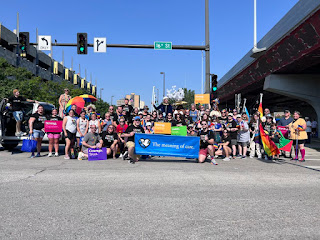
I'm on a couple of committees at our church, and one of the things we wanted to do was take part in this year's Heartland Pride Parade.
And I'm glad I participated alongside thousands of other people.
I mean, for all the many, many things that make us unique individuals, we're still one...we're still members of the human race.
Labels:
2024,
activities,
church,
Heartland,
Nebraska,
Omaha,
parade,
participation,
Pride,
support,
welcoming
Tuesday, January 24, 2023
Dear Rozanne:
It's been eleven days since you passed away...and I still think about you.
We had some great, great times together in the twenty-five years since we first met at the church you joined when you were little.
Man, you touched bunches and bunches of lives...not just at church, but also during the years where you delivered flowers and all the years you brought "Omaha World-Heralds."
You really brought the enthusiasm...especially at those concerts we attended. Didn't matter if they were RCTOS events or GPRS ones...or the times it was just you and me at the Pink Poodle Steakhouse.
Rozanne, you set one heck of an example for the rest of us to follow. You stood tough.
And I'm going to keep trying my best to live up to that example.
So doggone glad for the privilege of being a part of your life...and I'm so doggone glad you were (and still are!) a part of my life.
Thanks so much for everything!
Sincerely, Jim
Sunday, November 4, 2018
And what's more, the school didn't look the same!
Well, it was Sunday, 9-23-2018...the third and final day of the Class of 1973's 45th get-together in the Des Moines area.
This time, the final major activity of the reunion was scheduled to take place at the very school itself: West Des Moines Dowling Catholic High School.
Nope...not a pep rally.
No, not another sports event.
It was a Mass.
And two of our classmates- now men of the cloth- were tabbed to say that morning's Mass.
But first...it was time for interested classmates to tour the very school that gave so many of us so many great, great memories. (This was the tour that was originally scheduled for the previously Friday afternoon.)
And, thanks to a recent construction project, the physical plant at 1400 Buffalo Rd. is bigger and better than before.
Our host for the understandably brief tour was Ron Gray...the longtime (and legendary) DCHS head wrestling coach who's now the longest-tenured teacher in school history.
He's been at it for a whopping 41 years!
We got a chance to tour the hallways (lockers, trophy case, and all) and Ron's classroom. (By the way...in addition to currently being the school's head boys' golf coach and head girls' golf coach, he teaches economics and social studies.)
What if we'd had this kind of a classroom back in the late 1960s and early 1970s?
Okay...it's not really the size of the classroom (or style of classroom) that counts.
Now it was 10:30 AM...and time for Mass.
I hadn't been to an out-of-town one since Saturday, 6-11-2005.
It's a long story (and a possible blog post in itself), but after high school, I largely stopped going to church (only to go back to Mass on visits to Des Moines while an Iowa State student).
I'd had my fill of the downbeat messages the monsignor at the Catholic church I was going to in DSM was giving his parishioners. (Whenever the church wasn't taking in enough money to suit the monsignor there, he'd tell the churchgoers: "You're throwing defiles in God's face!")
I switched to the Unitarian Universalist Church not long after I first moved to Omaha in 1980...only because First Unitarian is within walking distance of where I first lived when I moved to the Big O on 8-2-1980. (I moved back here on 3-29-1997.)
Moved to Sioux City, IA on 6-30-1988 to manage a used-record-and-tape store...and spent the next five years and two months shunning church services.
All this time, though, I'd still go into church basements and get some practice in on those congregations' old-fashioned upright pianos (something I started doing in October 1976, back in Ames).
Well, that all changed in February 1994.
That was the month I decided to fill up the hole in my life and join the United Methodist Church.
I've felt more comfortable as a United Methodist than I ever did as a Catholic.
Even so, that wasn't going to stop me from participating in a Mass that Jim Gould and Dennis Wright were to preside over.
It was supposed to be Mike Peters teaming up with fellow Catholic priest Jim G., but Mike P. got called away to another assignment.
So Dennis W., now a deacon in the Des Moines area, took Mike's place. (I remember Dennis' cartoons in the school newspaper...the publication originally called The Aquin but renamed The Paper once the old, all-boys' Dowling merged with the all-girls' St. Joseph Academy in time for the 1972-73 school year and set up shop on Buffalo Rd. in the 'burbs.)
The Mass took place at DCHS' brand-new St. Joseph Chapel, a much bigger one than the chapel that originally came with the new Dowling.
And it went beautifully...from Julie Russell Craven's music (she played the hymns on an electronic keyboard) to Jim G.'s homily to everything else.
Once the service- meant to honor the 29 classmates who've passed away- was finished, we went right to the school lobby for coffee and donuts.
This coffee-and-donuts session was more enjoyable than those I was able to attend when I was younger and going to a church whose top priest railed away about all those defiles.
Tom Meyer, Ron G., Jim G., Dennis W., Julie R., hubby David Craven, and I got together with Joni Hockins Edwards, Lisa Lamberto (one of Joni's fellow cheerleaders), Meg Tibbetts Williams, Margo Munoz O'Meara (never had a chance to see her at the other reunion events), and so many other classmates to talk up old memories and current goings-on.
We had such a great time that our time together ran into overtime...and the DCHS Class of 1973's 45th Reunion broke up around 12:15 PM.
All I can say is:
Please, please, PLEASE let circumstances allow me to get to the 50th Class of '73 get-together!
About that Mass I went to on 6-11-2005: The Mass was actually a wedding of Matt and Liz, a young couple I met earlier that year at the Omaha Children's Museum. (From October 1997 to June 2006, I volunteered at the OCM, where they let me entertain visitors of all ages on an old-fashioned upright piano in the museum's music room. The best part of it all: When I wasn't playing, I got a chance to hear the children and some of the adults they brought with them tickle those ancient keys.)
After they heard me play, Liz and Matt invited me to perform at their wedding reception. I said "yes," and on the second Saturday in June that year, I traveled to Shenandoah, IA, to watch the two of them become husband and wife.
I'm Jim Boston...thanks for reading this blog!
This time, the final major activity of the reunion was scheduled to take place at the very school itself: West Des Moines Dowling Catholic High School.
Nope...not a pep rally.
No, not another sports event.
It was a Mass.
And two of our classmates- now men of the cloth- were tabbed to say that morning's Mass.
But first...it was time for interested classmates to tour the very school that gave so many of us so many great, great memories. (This was the tour that was originally scheduled for the previously Friday afternoon.)
And, thanks to a recent construction project, the physical plant at 1400 Buffalo Rd. is bigger and better than before.
Our host for the understandably brief tour was Ron Gray...the longtime (and legendary) DCHS head wrestling coach who's now the longest-tenured teacher in school history.
He's been at it for a whopping 41 years!
We got a chance to tour the hallways (lockers, trophy case, and all) and Ron's classroom. (By the way...in addition to currently being the school's head boys' golf coach and head girls' golf coach, he teaches economics and social studies.)
What if we'd had this kind of a classroom back in the late 1960s and early 1970s?
Okay...it's not really the size of the classroom (or style of classroom) that counts.
Now it was 10:30 AM...and time for Mass.
I hadn't been to an out-of-town one since Saturday, 6-11-2005.
It's a long story (and a possible blog post in itself), but after high school, I largely stopped going to church (only to go back to Mass on visits to Des Moines while an Iowa State student).
I'd had my fill of the downbeat messages the monsignor at the Catholic church I was going to in DSM was giving his parishioners. (Whenever the church wasn't taking in enough money to suit the monsignor there, he'd tell the churchgoers: "You're throwing defiles in God's face!")
I switched to the Unitarian Universalist Church not long after I first moved to Omaha in 1980...only because First Unitarian is within walking distance of where I first lived when I moved to the Big O on 8-2-1980. (I moved back here on 3-29-1997.)
Moved to Sioux City, IA on 6-30-1988 to manage a used-record-and-tape store...and spent the next five years and two months shunning church services.
All this time, though, I'd still go into church basements and get some practice in on those congregations' old-fashioned upright pianos (something I started doing in October 1976, back in Ames).
Well, that all changed in February 1994.
That was the month I decided to fill up the hole in my life and join the United Methodist Church.
I've felt more comfortable as a United Methodist than I ever did as a Catholic.
Even so, that wasn't going to stop me from participating in a Mass that Jim Gould and Dennis Wright were to preside over.
It was supposed to be Mike Peters teaming up with fellow Catholic priest Jim G., but Mike P. got called away to another assignment.
So Dennis W., now a deacon in the Des Moines area, took Mike's place. (I remember Dennis' cartoons in the school newspaper...the publication originally called The Aquin but renamed The Paper once the old, all-boys' Dowling merged with the all-girls' St. Joseph Academy in time for the 1972-73 school year and set up shop on Buffalo Rd. in the 'burbs.)
The Mass took place at DCHS' brand-new St. Joseph Chapel, a much bigger one than the chapel that originally came with the new Dowling.
And it went beautifully...from Julie Russell Craven's music (she played the hymns on an electronic keyboard) to Jim G.'s homily to everything else.
Once the service- meant to honor the 29 classmates who've passed away- was finished, we went right to the school lobby for coffee and donuts.
This coffee-and-donuts session was more enjoyable than those I was able to attend when I was younger and going to a church whose top priest railed away about all those defiles.
Tom Meyer, Ron G., Jim G., Dennis W., Julie R., hubby David Craven, and I got together with Joni Hockins Edwards, Lisa Lamberto (one of Joni's fellow cheerleaders), Meg Tibbetts Williams, Margo Munoz O'Meara (never had a chance to see her at the other reunion events), and so many other classmates to talk up old memories and current goings-on.
We had such a great time that our time together ran into overtime...and the DCHS Class of 1973's 45th Reunion broke up around 12:15 PM.
All I can say is:
Please, please, PLEASE let circumstances allow me to get to the 50th Class of '73 get-together!
About that Mass I went to on 6-11-2005: The Mass was actually a wedding of Matt and Liz, a young couple I met earlier that year at the Omaha Children's Museum. (From October 1997 to June 2006, I volunteered at the OCM, where they let me entertain visitors of all ages on an old-fashioned upright piano in the museum's music room. The best part of it all: When I wasn't playing, I got a chance to hear the children and some of the adults they brought with them tickle those ancient keys.)
After they heard me play, Liz and Matt invited me to perform at their wedding reception. I said "yes," and on the second Saturday in June that year, I traveled to Shenandoah, IA, to watch the two of them become husband and wife.
I'm Jim Boston...thanks for reading this blog!
Labels:
1973,
Catholics,
church,
class,
Des Moines,
Dowling Catholic,
fun,
high school,
Iowa,
Mass,
memories,
reunion,
Ron Gray,
teachers,
tour,
Unitarians,
United Methodists,
West Des Moines
Saturday, July 16, 2016
I've Got Some Really Good News and Some Very Bad News
First, the very bad news:
Only six tickets were sold for this year's Ragtime to Riches Festival, held at Omaha's First Central Congregational United Church of Christ. (Last year, the Great Plains Ragtime Society sold thirteen ducats.)
Now here's the really good news:
All the attendees really enjoyed themselves at this past Sunday's event.
Admittedly, 7-10-2016 was a scorcher here in the River City. (7-12-2015- the day of the previous R to R Festival- turned out to be hot outside here in Nebraska's largest city, too.)
Well, some things were different about the twelfth R to R. One of the differences was...a new workshop presenter.
2016 represented Faye Ballard's first year of giving a Ragtime to Riches workshop. This year's topic was one that one of the 2006 performers, Nan Bostick (one of the best ragtime historians who ever lived), touched on: "Women in Ragtime."
And like Nan's presentation from a decade ago, Faye's presentation hit the spot.
The Champaign, IL native presented a dozen rags by women composers. (Did you know that at least 500 women wrote one rag or more apiece during the 1899-1917 period?)
For me, some of the standouts in Faye's workshop were "The Allen Glide," written by Louise Allen in 1915; "Chicken Chowder," penned a decade earlier by a St. Louis teenager named Irene Giblin; Adeline Shepard's rousing "Pickles and Peppers;" "The Thriller," a 1909 May Aufderheide rag; and a 1907 number, Julia Lee Niebergall's "Hoosier Rag."
When it came time to change from workshop presenter to concert performer, Faye switched the focus to some of ragtime's men composers. First up was "The Harlem Rag," the Tom Turpin piece that was the first published rag written by an African-American composer; then 1899's "Original Rags," the first of five Scott Joplin numbers the recently-retired office manager from Central Illinois played at this year's R to R.
Faye didn't leave the other two members of ragtime's Big Three behind; she turned in James Scott's "Frog Legs Rag" and Joseph Lamb's "Ragtime Nightingale."
Then she gave two examples of what rag pianists would play in the "cutting contests" of that 1899-1917 period: "It Had to Be You" and "Mack the Knife," both of which actually were written in the 1920s...long after the Ragtime Era ended.
Faye wrapped it all up by coming up with a fine, fine version of "Twelfth Street Rag."
I was scheduled to go up at 4:15 PM (Central time)...but I ended up deciding to start my own concert at 4:30 PM after helping Marty Mincer get set up for the anchor leg of R to R 2016. (We'll take a look at the anchor leg later!)
Actually...my turn at bat had a head start, preceding the workshop by ten minutes, the better to help out a festival fan who needed to attend her oldest grandson's birthday party.
So I wrapped up the festival's open-piano session with my first two concert selections: "In the Good Old Summertime" and "Way Down Yonder in New Orleans."
Once the clock ticked 4:30 PM, I picked my own concert thread back up and continued to focus on tunes I'd done in competition at the event Faye serves as its coordinator: The World Championship Old-Time Piano Playing Contest and Festival.
Mindful of the fact that the Illinois-turned-Mississippi competition started out as a fundraiser for the Monticello (IL) Railway Museum, and thinking about how contestants initially had to choose a rail-related song among their selections, I offered up "I've Been Workin' on the Railroad..." one of just two numbers I'd been able to play as a finalist (the year was 1994).
In addition, George Giefer's 1899 winner "Who Threw the Overalls in Mrs. Murphy's Chowder?" worked out fine (well, at least the audience thought so); so did my closer, "In My Merry Oldsmobile."
This concert included three rags: Charles Hunter's 1899 "Tickled to Death," W.C. Polla's 1904 "Funny Folks," and E. Warren Furry's only rag of consequence, his 1902 "Robardina Rag."
And this machine operator from here in Omaha (by way of Des Moines, IA) called an audible, replacing would-be selection "Grand March (from 'Aida')" with "Take Your Girlie to the Movies (If You Can't Make Love at Home)."
Speaking of movies...the R to R anchor leg was a movie.
For the first time in R to R history, we'd show a silent film. In this case, it was Harold Lloyd's 1920 winner "Get Out and Get Under."
And instead of giving a conventional concert, Marty was in town to cue the movie.
With Marty (the apple farmer from Hamburg, IA) providing the DVD, some friends from the church I go to providing a DVD projector, and First Central itself coming up with a DVD player, we were ready to go.
We didn't even need a screen.
The DVD projector went on top of the church's turn-of-the-20th-Century Anderson & Newton upright piano and was aimed at one of the blank walls at the church's Memorial Hall.
That setup worked out fine.
Marty's accompaniment (on the church's turn-of-the-21st-Century Yamaha grand piano) was right on. (He even threw some post-1920 wrinkles in there, and also pulled out a song from 1962- "Puff, the Magic Dragon-" during a scene where Harold was lighting up a cigarette.)
"Get Out and Get Under" was some kind of hilarious.
Now if we'd been able to get more people to come to First Central this past Sunday.
I'm thinking of some projects that can get more people (especially people here in the Omaha/Council Bluffs/Bellevue area) to check out the R to R Festival...and help keep old-time piano alive.
If you've got any suggestions, feel free to pass them along. (Nope...giving up isn't an option!)
It's time for some really good news and some very GOOD news.
Only six tickets were sold for this year's Ragtime to Riches Festival, held at Omaha's First Central Congregational United Church of Christ. (Last year, the Great Plains Ragtime Society sold thirteen ducats.)
Now here's the really good news:
All the attendees really enjoyed themselves at this past Sunday's event.
Admittedly, 7-10-2016 was a scorcher here in the River City. (7-12-2015- the day of the previous R to R Festival- turned out to be hot outside here in Nebraska's largest city, too.)
Well, some things were different about the twelfth R to R. One of the differences was...a new workshop presenter.
2016 represented Faye Ballard's first year of giving a Ragtime to Riches workshop. This year's topic was one that one of the 2006 performers, Nan Bostick (one of the best ragtime historians who ever lived), touched on: "Women in Ragtime."
And like Nan's presentation from a decade ago, Faye's presentation hit the spot.
The Champaign, IL native presented a dozen rags by women composers. (Did you know that at least 500 women wrote one rag or more apiece during the 1899-1917 period?)
For me, some of the standouts in Faye's workshop were "The Allen Glide," written by Louise Allen in 1915; "Chicken Chowder," penned a decade earlier by a St. Louis teenager named Irene Giblin; Adeline Shepard's rousing "Pickles and Peppers;" "The Thriller," a 1909 May Aufderheide rag; and a 1907 number, Julia Lee Niebergall's "Hoosier Rag."
When it came time to change from workshop presenter to concert performer, Faye switched the focus to some of ragtime's men composers. First up was "The Harlem Rag," the Tom Turpin piece that was the first published rag written by an African-American composer; then 1899's "Original Rags," the first of five Scott Joplin numbers the recently-retired office manager from Central Illinois played at this year's R to R.
Faye didn't leave the other two members of ragtime's Big Three behind; she turned in James Scott's "Frog Legs Rag" and Joseph Lamb's "Ragtime Nightingale."
Then she gave two examples of what rag pianists would play in the "cutting contests" of that 1899-1917 period: "It Had to Be You" and "Mack the Knife," both of which actually were written in the 1920s...long after the Ragtime Era ended.
Faye wrapped it all up by coming up with a fine, fine version of "Twelfth Street Rag."
I was scheduled to go up at 4:15 PM (Central time)...but I ended up deciding to start my own concert at 4:30 PM after helping Marty Mincer get set up for the anchor leg of R to R 2016. (We'll take a look at the anchor leg later!)
Actually...my turn at bat had a head start, preceding the workshop by ten minutes, the better to help out a festival fan who needed to attend her oldest grandson's birthday party.
So I wrapped up the festival's open-piano session with my first two concert selections: "In the Good Old Summertime" and "Way Down Yonder in New Orleans."
Once the clock ticked 4:30 PM, I picked my own concert thread back up and continued to focus on tunes I'd done in competition at the event Faye serves as its coordinator: The World Championship Old-Time Piano Playing Contest and Festival.
Mindful of the fact that the Illinois-turned-Mississippi competition started out as a fundraiser for the Monticello (IL) Railway Museum, and thinking about how contestants initially had to choose a rail-related song among their selections, I offered up "I've Been Workin' on the Railroad..." one of just two numbers I'd been able to play as a finalist (the year was 1994).
In addition, George Giefer's 1899 winner "Who Threw the Overalls in Mrs. Murphy's Chowder?" worked out fine (well, at least the audience thought so); so did my closer, "In My Merry Oldsmobile."
This concert included three rags: Charles Hunter's 1899 "Tickled to Death," W.C. Polla's 1904 "Funny Folks," and E. Warren Furry's only rag of consequence, his 1902 "Robardina Rag."
And this machine operator from here in Omaha (by way of Des Moines, IA) called an audible, replacing would-be selection "Grand March (from 'Aida')" with "Take Your Girlie to the Movies (If You Can't Make Love at Home)."
Speaking of movies...the R to R anchor leg was a movie.
For the first time in R to R history, we'd show a silent film. In this case, it was Harold Lloyd's 1920 winner "Get Out and Get Under."
And instead of giving a conventional concert, Marty was in town to cue the movie.
With Marty (the apple farmer from Hamburg, IA) providing the DVD, some friends from the church I go to providing a DVD projector, and First Central itself coming up with a DVD player, we were ready to go.
We didn't even need a screen.
The DVD projector went on top of the church's turn-of-the-20th-Century Anderson & Newton upright piano and was aimed at one of the blank walls at the church's Memorial Hall.
That setup worked out fine.
Marty's accompaniment (on the church's turn-of-the-21st-Century Yamaha grand piano) was right on. (He even threw some post-1920 wrinkles in there, and also pulled out a song from 1962- "Puff, the Magic Dragon-" during a scene where Harold was lighting up a cigarette.)
"Get Out and Get Under" was some kind of hilarious.
Now if we'd been able to get more people to come to First Central this past Sunday.
I'm thinking of some projects that can get more people (especially people here in the Omaha/Council Bluffs/Bellevue area) to check out the R to R Festival...and help keep old-time piano alive.
If you've got any suggestions, feel free to pass them along. (Nope...giving up isn't an option!)
It's time for some really good news and some very GOOD news.
Monday, July 27, 2015
Who Said You Can't Play a Rag on the Violin?
If that's what you believe, you should've come to Omaha's First Central Congregational United Church of Christ on 7-12-2015...the day of the eleventh annual Ragtime to Riches Festival.
More about that later.
But first of all...it started with a heckler.
He came into the church's Memorial Hall at about 1:30 PM (Central time); he announced that he was trying to cool off. (It was 95 degrees Fahrenheit here in Omaha at that time that Sunday.)
At that time, Nick Holle (who codirected the 2012 documentary movie "The Entertainers"), Faye Ballard (one of the movie's stars), Daniel Souvigny (old-time piano's newest star), Danny's mom Vicky, and Marc May (nope, football fans, not the one from ESPN; I'm talking about a local free-lance photographer I play alongside in our church's praise band) were in the building with me.
Daniel (one of Faye's students, by the way) was warming up on both R to R pianos- that battle-tested turn-of-the-20th-Century Anderson & Newton upright as well as a brand-new, 2015 Yamaha grand brought in to replace the church's 1920s Mason & Hamlin grand.
Heckler heard Daniel go to town on one piano after the other...then wondered out loud: "Who's that?"
The question-and-answer session continued after Vicky, Faye, and Daniel left to get a bite to eat. Eventually, the questions began to get personal. (One of those was directed at me after Heckler took a look at the cover of one of my CDs: "Did you lose weight?")
Yes, I did. I'd lost weight since December of 2011...when my profile picture was taken.
Take a look at that profile pic. It was snapped at an antiques shop in Omaha's Old Market.
The store had concrete walls, and I was in the Old Market on a cold day...and concrete walls just don't do a good job of keeping the cold out.
To beat all of that, I had on five layers of clothing.
Too bad Mr. Heckler couldn't think about that.
And the Man Who Wanted to Beat the Heat was becoming the Smart Aleck in the Room.
So...it became 1:55 PM. In five minutes, R to R 11.0 would officially begin.
Heckler hadn't made up his mind yet.
I told him: "You can either stay and pay the $10 (admission) or you can leave."
Mr. Smart Aleck left the church.
After Mr. Jerk (well, that's what somebody else called him!) left First Central, an audience began to build...and, at 2:15 PM, Ragtime to Riches 2015 began with a workshop about how Tin Pan Alley worked in the 1920s.
This year's workshop went more smoothly than the 2014 effort...only because, this time around, I buckled down and prepared so that I wouldn't need to keep looking at my note cards.
I didn't want to look like a dork.
In preparing for R to R's 2015 workshop, I went back and reread my post about last year's Ragtime to Riches ("The Tenth Time Around!")...and realized I'd skipped a decade. (In 2014, I talked about the Alley's 1900-1909 period...and I promised that the 2015 workshop would focus on 1910-1919.)
Oops!
So...I went ahead and spotlighted the Roaring Twenties in this year's workshop...and I'd pick up the Taft-Wilson years- okay, the bulk of the Taft years plus the lion's share of the Wilson years- during the Omaha event's first concert (at 3:00 PM, right on the nose).
As things turned out, it all fit nicely. After all, the audience found out that the 1920-1929 period was the most prolific decade in Tin Pan Alley history (all because composers and performers alike wanted to come up with the next "Tiger Rag," what with the 1917 tune's 1918 debut as a recording ushering in the Jazz Age)...and this year's first R to R concert was set up to show how the Ragtime Age morphed into the Jazz Age.
Planned on eleven numbers...but I ended up getting eight of 'em off, starting with 1910's "By the Light of the Silvery Moon" and including 1914's "St. Louis Blues" (the first written blues number ever published) and closing it all out with..."Tiger Rag."
The only other rag in the set was 1910's "Spaghetti Rag."
Well, the audience did enjoy R to R Concert #1...and it ended at 4:00 PM, right on the nose.
Fifteen minutes later, that fourteen-year-old sensation from Hampshire, IL (on the northwest edge of the Chicagoland area) made his Nebraska debut...and took to that brand-new Yamaha grand.
And he rocked it!
Daniel's first number was Adeline Shepard's "Pickles and Peppers," one of the tunes he and fellow World Championship Old-Time Piano Playing Contest and Festival participant (and fellow Illinoisan) Nathan Beasley had fun with this past Memorial Day weekend.
Danny went on to craft a lively, fourteen-selection set that included several tunes found in the three-time OTPP Junior Division champ's latest CD, "Possibilities." (If you haven't heard this collaboration with noted jazz drummer Danny Coots, you're in for one heck of a treat!)
The R to R audience heard Daniel Souvigny put forth "Possibilities" cuts such as Clarence Wiley's "Car-Bar-Lick Acid," Andy Razaf's and Fats Waller's "Honeysuckle Rose," and "Ham And!"
Then, for his eleventh number, Daniel really broke it open.
He did it by breaking out his violin.
Faye came over to the Yamaha and turned Danny's next offering into a duet...in this case, Scott Joplin's "Bethena," the most famous ragtime waltz ever composed.
Daniel reeled the Memorial Hall crowd in...and won 'em over.
He put an exclamation point at the end of it all by playing Nat Ayer's "King Chanticleer." (On the Yamaha piano, not his violin!)
Two concerts down...one to go.
When Faye took to the Memorial Hall stage at 7:00 PM to run R to R 2015's anchor leg, she wanted to take something from Danny's playbook (she called him "the technician") and something from my own playbook (she termed me "the historian").
What OTPP's contest coordinator (who's also an office manager at the Center for Innovation in Teaching and Learning at her alma mater, the University of Illinois at Urbana-Champaign) came up with was a continuation of her "Ragtime 101" concert from last year's turn here in the Big O...and it was still some kind of special.
Faye kicked her set off with two of her all-time favorites: "Sailin' Away on the Henry Clay" and "It Had to Be You."
After using those two numbers to show how songs can be turned into rags, Faye Ballard shifted the music to "Harlem Rag," the first published rag written by an African-American composer (in this case, Thomas Million Turpin).
And following her tribute to ragtime's Big Three (that's right: Scott Joplin, James Scott, and Joseph Lamb), it was Full Circle Time.
That's absolutely right: Faye invited Daniel to come back up. This time, the two Illinoisans reprised a tune Danny did that afternoon, "Pork and Beans," and made it into a duet.
Faye's renditions of May Aufderheide's "The Thriller" and of Julia Niebergall's "Horseshoe Rag" came before her closing number, Zez Confrey's digit-busting "Dizzy Fingers."
All in all, the audience (filling up 40% of Memorial Hall) came to enjoy the eleventh annual Ragtime to Riches Festival, and they'd like to see more syncopated events come to the Omaha/Council Bluffs/Bellevue area. (Who knows, what with OTPP's future still up in the air? Perhaps this is a real opportunity for R to R to gain more of a following.)
Oh, by the way...the Great Plains Ragtime Society took in $130 from ticket sales this time around.
More about that later.
But first of all...it started with a heckler.
He came into the church's Memorial Hall at about 1:30 PM (Central time); he announced that he was trying to cool off. (It was 95 degrees Fahrenheit here in Omaha at that time that Sunday.)
At that time, Nick Holle (who codirected the 2012 documentary movie "The Entertainers"), Faye Ballard (one of the movie's stars), Daniel Souvigny (old-time piano's newest star), Danny's mom Vicky, and Marc May (nope, football fans, not the one from ESPN; I'm talking about a local free-lance photographer I play alongside in our church's praise band) were in the building with me.
Daniel (one of Faye's students, by the way) was warming up on both R to R pianos- that battle-tested turn-of-the-20th-Century Anderson & Newton upright as well as a brand-new, 2015 Yamaha grand brought in to replace the church's 1920s Mason & Hamlin grand.
Heckler heard Daniel go to town on one piano after the other...then wondered out loud: "Who's that?"
The question-and-answer session continued after Vicky, Faye, and Daniel left to get a bite to eat. Eventually, the questions began to get personal. (One of those was directed at me after Heckler took a look at the cover of one of my CDs: "Did you lose weight?")
Yes, I did. I'd lost weight since December of 2011...when my profile picture was taken.
Take a look at that profile pic. It was snapped at an antiques shop in Omaha's Old Market.
The store had concrete walls, and I was in the Old Market on a cold day...and concrete walls just don't do a good job of keeping the cold out.
To beat all of that, I had on five layers of clothing.
Too bad Mr. Heckler couldn't think about that.
And the Man Who Wanted to Beat the Heat was becoming the Smart Aleck in the Room.
So...it became 1:55 PM. In five minutes, R to R 11.0 would officially begin.
Heckler hadn't made up his mind yet.
I told him: "You can either stay and pay the $10 (admission) or you can leave."
Mr. Smart Aleck left the church.
After Mr. Jerk (well, that's what somebody else called him!) left First Central, an audience began to build...and, at 2:15 PM, Ragtime to Riches 2015 began with a workshop about how Tin Pan Alley worked in the 1920s.
This year's workshop went more smoothly than the 2014 effort...only because, this time around, I buckled down and prepared so that I wouldn't need to keep looking at my note cards.
I didn't want to look like a dork.
In preparing for R to R's 2015 workshop, I went back and reread my post about last year's Ragtime to Riches ("The Tenth Time Around!")...and realized I'd skipped a decade. (In 2014, I talked about the Alley's 1900-1909 period...and I promised that the 2015 workshop would focus on 1910-1919.)
Oops!
So...I went ahead and spotlighted the Roaring Twenties in this year's workshop...and I'd pick up the Taft-Wilson years- okay, the bulk of the Taft years plus the lion's share of the Wilson years- during the Omaha event's first concert (at 3:00 PM, right on the nose).
As things turned out, it all fit nicely. After all, the audience found out that the 1920-1929 period was the most prolific decade in Tin Pan Alley history (all because composers and performers alike wanted to come up with the next "Tiger Rag," what with the 1917 tune's 1918 debut as a recording ushering in the Jazz Age)...and this year's first R to R concert was set up to show how the Ragtime Age morphed into the Jazz Age.
Planned on eleven numbers...but I ended up getting eight of 'em off, starting with 1910's "By the Light of the Silvery Moon" and including 1914's "St. Louis Blues" (the first written blues number ever published) and closing it all out with..."Tiger Rag."
The only other rag in the set was 1910's "Spaghetti Rag."
Well, the audience did enjoy R to R Concert #1...and it ended at 4:00 PM, right on the nose.
Fifteen minutes later, that fourteen-year-old sensation from Hampshire, IL (on the northwest edge of the Chicagoland area) made his Nebraska debut...and took to that brand-new Yamaha grand.
And he rocked it!
Daniel's first number was Adeline Shepard's "Pickles and Peppers," one of the tunes he and fellow World Championship Old-Time Piano Playing Contest and Festival participant (and fellow Illinoisan) Nathan Beasley had fun with this past Memorial Day weekend.
Danny went on to craft a lively, fourteen-selection set that included several tunes found in the three-time OTPP Junior Division champ's latest CD, "Possibilities." (If you haven't heard this collaboration with noted jazz drummer Danny Coots, you're in for one heck of a treat!)
The R to R audience heard Daniel Souvigny put forth "Possibilities" cuts such as Clarence Wiley's "Car-Bar-Lick Acid," Andy Razaf's and Fats Waller's "Honeysuckle Rose," and "Ham And!"
Then, for his eleventh number, Daniel really broke it open.
He did it by breaking out his violin.
Faye came over to the Yamaha and turned Danny's next offering into a duet...in this case, Scott Joplin's "Bethena," the most famous ragtime waltz ever composed.
Daniel reeled the Memorial Hall crowd in...and won 'em over.
He put an exclamation point at the end of it all by playing Nat Ayer's "King Chanticleer." (On the Yamaha piano, not his violin!)
Two concerts down...one to go.
When Faye took to the Memorial Hall stage at 7:00 PM to run R to R 2015's anchor leg, she wanted to take something from Danny's playbook (she called him "the technician") and something from my own playbook (she termed me "the historian").
What OTPP's contest coordinator (who's also an office manager at the Center for Innovation in Teaching and Learning at her alma mater, the University of Illinois at Urbana-Champaign) came up with was a continuation of her "Ragtime 101" concert from last year's turn here in the Big O...and it was still some kind of special.
Faye kicked her set off with two of her all-time favorites: "Sailin' Away on the Henry Clay" and "It Had to Be You."
After using those two numbers to show how songs can be turned into rags, Faye Ballard shifted the music to "Harlem Rag," the first published rag written by an African-American composer (in this case, Thomas Million Turpin).
And following her tribute to ragtime's Big Three (that's right: Scott Joplin, James Scott, and Joseph Lamb), it was Full Circle Time.
That's absolutely right: Faye invited Daniel to come back up. This time, the two Illinoisans reprised a tune Danny did that afternoon, "Pork and Beans," and made it into a duet.
Faye's renditions of May Aufderheide's "The Thriller" and of Julia Niebergall's "Horseshoe Rag" came before her closing number, Zez Confrey's digit-busting "Dizzy Fingers."
All in all, the audience (filling up 40% of Memorial Hall) came to enjoy the eleventh annual Ragtime to Riches Festival, and they'd like to see more syncopated events come to the Omaha/Council Bluffs/Bellevue area. (Who knows, what with OTPP's future still up in the air? Perhaps this is a real opportunity for R to R to gain more of a following.)
Oh, by the way...the Great Plains Ragtime Society took in $130 from ticket sales this time around.
Labels:
Anderson & Newton,
church,
Daniel Souvigny,
event,
Faye Ballard,
festival,
First Central,
fundraiser,
grand,
Great Plains Ragtime Society,
Nebraska,
Omaha,
piano,
ragtime,
upright,
Yamaha
Tuesday, July 29, 2014
The Tenth Time Around!
Well...we did it.
On Sunday, 7-13-2014, at Omaha's First Central Congregational United Church of Christ, the Great Plains Ragtime Society staged the tenth version of an event called the Ragtime to Riches Festival.
Okay...we didn't completely fill up the church's Memorial Hall. But we did get more of an audience this time around than in 2013.
And right from the time the doors opened (1:00 PM Central time), the place was jumpin'.
The first event right after the doors of First Central's Memorial Hall open is an open-piano session.
So glad someone else got it going.
And, at this year's open-piano hour, Brent Watkins (he competed in the early 2000s at the World Championship Old-Time Piano Playing Contest and Festival, then went on to coproduce the first documentary about the event) got the ball rolling on one of the two pianos at Memorial Hall. (Brent did "Maple Leaf Rag" on the hall's 1920s Mason & Hamlin grand; eventually, he tried the other piano...a 1900s-or-so Anderson & Newton upright.)
I'm glad Brent went up to bat first, because I was still nervous about the second R to R event...something I was still furiously preparing for.
People started coming in while the man from Iowa City (by way of Cedar Rapids, IA) continued to knock out rags. And by 2:00 PM, we got our biggest audience of this year's festival.
And those thirteen people watched me switch between contemporaneous speaking, the use of note cards, and a few turns on that A&N upright...as I delivered a workshop about how Tin Pan Alley sounded during the 1900-1909 period.
The main message I tried to get across was that, when the 20th Century started to kick in, America's music publishing industry started to grow and grow and grow...not just physically, but also in influence, what with more and more people coming over from other lands to get in on the bounty America had to offer. (And in many cases, the newcomers of the early 20th Century met with real resistance, too...just like the newcomers right here in the early 21st Century.)
Plus: The resistance of 100-110 years ago showed up in lots of Tin Pan Alley songs.
And...did I mention that Broadway was starting to become an entertainment force at that very moment, thanks to composers like George M. Cohan?
Originally, this workshop was to stop at 1919...but to cover nineteen years in sixty minutes felt more like a fly-by overview. (Even so, chopping off the 1910s turned the presentation into a drive-by summary. But the crowd- including an official from the Nebraska Department of Education, John Sieler- liked it.)
They liked it even more when Faye Ballard took to the stage.
The OTPP contest coordinator/collegiate office manager from Champaign, IL delivered a concert that doubled as Ragtime 101. In her first Ragtime to Riches, Faye turned in a set that emphasized the music of ragtime's Big Three (that's right- Scott Joplin, James Scott, and Joseph Lamb).
And for good measure, this star of "The Entertainers" (the movie Brent coproduced) threw in Zez Confrey's "Dizzy Fingers," Jelly Roll Morton's "Grandpa's Spell," and three of her signature numbers: "Sailin' Away on the Henry Clay," "Mack the Knife," and "It Had to Be You." (Maybe you've seen Faye's version of "Mack the Knife" on YouTube.)
When Faye's 14-tune concert wrapped up, we showed...that's right, we showed "The Entertainers."
Now if eight of those thirteen people had stuck around to see the film...they would've loved it, too.
At the end of each showing of the now two-year-old documentary, there's a question-and-answer session. Usually, Nick Holle (he was here in Omaha for this year's R to R) conducts it; sometimes, his fellow "Entertainers" codirector, Michael Zimmer, does the honors (which was the case when the movie was shown in San Diego on 3-14-2014). And the rest of the time, Michael and Nick team up to field audience questions.
This time, the Q-and-A involved an audience of one: A local pianist named Kevin Robinson. (Check out his "Play Me, I'm Yours" videos on www.youtube.com.)
Still, this Q-and-A session was no less effective than previous ones. (And I remember when Redd Foxx talked about being able to entertain a one-person audience!)
Well, another open-piano session took place (with Faye and Brent taking to both pianos); after that, Nick, Brent, Faye, and I ate dinner (we got take-out food from a neighborhood restaurant called Crescent Moon Ale House; it's at 3578 Farnam St., 68131).
Then, at 7:30 PM, it was time for the last event of the 2014 Ragtime to Riches get-together.
Last year, I built my own concert around the memory of some of the big-name newsmakers and big-name celebrities who passed away in 2012, focusing on the Number One recording on the day this or that personality came into the world. (For instance, "For Me and My Gal," recorded by the duo of Van & Schenck, hit the top spot on the pop charts on 7-17-1917...the very day Phyllis Diller was born. And I even ragged up "So Much in Love," the leading pop hit on the Billboard charts on 8-9-1963...Whitney Houston's birthdate.)
For 2014, since this year's R to R would be the tenth one, I wanted to call up tunes whose titles had a T, an E, and an N...in that order.
As a result, the fans who hung around got to hear numbers like "A Hot Time in the Old Town Tonight," "Listen to the Mockingbird," "After You've Gone," and "Hardhearted Hannah." There was also a 1952 song from composers Johnny Lange and Hy Heath, "There'll Be No New Tunes on This Old Piano." (Tennessee Ernie Ford put it on his 1962 album, "Here Comes the Mississippi Showboat." And I even saw him sing it on his old TV show when I was little.)
Two rags were in there, too: "The Entertainer" and something I wrote in 2001 (on an old piano, of course): "Stompin' at the Children's Museum."
I'd never performed my own rags at any R to R before...and I was relieved to find out the audience liked my ode to the nine years (1997-2006) I spent not only banging the 88s at the Omaha Children's Museum, but watching the children themselves (and some adults) show off their own skills on the old upright.
Some of Faye's (and some of my) offerings at the festival made it onto YouTube. (Just type in "Ragtime to Riches Festival.")
Man, we had a ball at R to R 10.0, and we raised $140 for the Great Plains Ragtime Society.
Don't know how the eleventh annual festival will shape up...but I do know this:
I hope you'll be able to check out next year's Omaha/Council Bluffs/Bellevue ragtime outing. We think you'll have a ball, too.
On Sunday, 7-13-2014, at Omaha's First Central Congregational United Church of Christ, the Great Plains Ragtime Society staged the tenth version of an event called the Ragtime to Riches Festival.
Okay...we didn't completely fill up the church's Memorial Hall. But we did get more of an audience this time around than in 2013.
And right from the time the doors opened (1:00 PM Central time), the place was jumpin'.
The first event right after the doors of First Central's Memorial Hall open is an open-piano session.
So glad someone else got it going.
And, at this year's open-piano hour, Brent Watkins (he competed in the early 2000s at the World Championship Old-Time Piano Playing Contest and Festival, then went on to coproduce the first documentary about the event) got the ball rolling on one of the two pianos at Memorial Hall. (Brent did "Maple Leaf Rag" on the hall's 1920s Mason & Hamlin grand; eventually, he tried the other piano...a 1900s-or-so Anderson & Newton upright.)
I'm glad Brent went up to bat first, because I was still nervous about the second R to R event...something I was still furiously preparing for.
People started coming in while the man from Iowa City (by way of Cedar Rapids, IA) continued to knock out rags. And by 2:00 PM, we got our biggest audience of this year's festival.
And those thirteen people watched me switch between contemporaneous speaking, the use of note cards, and a few turns on that A&N upright...as I delivered a workshop about how Tin Pan Alley sounded during the 1900-1909 period.
The main message I tried to get across was that, when the 20th Century started to kick in, America's music publishing industry started to grow and grow and grow...not just physically, but also in influence, what with more and more people coming over from other lands to get in on the bounty America had to offer. (And in many cases, the newcomers of the early 20th Century met with real resistance, too...just like the newcomers right here in the early 21st Century.)
Plus: The resistance of 100-110 years ago showed up in lots of Tin Pan Alley songs.
And...did I mention that Broadway was starting to become an entertainment force at that very moment, thanks to composers like George M. Cohan?
Originally, this workshop was to stop at 1919...but to cover nineteen years in sixty minutes felt more like a fly-by overview. (Even so, chopping off the 1910s turned the presentation into a drive-by summary. But the crowd- including an official from the Nebraska Department of Education, John Sieler- liked it.)
They liked it even more when Faye Ballard took to the stage.
The OTPP contest coordinator/collegiate office manager from Champaign, IL delivered a concert that doubled as Ragtime 101. In her first Ragtime to Riches, Faye turned in a set that emphasized the music of ragtime's Big Three (that's right- Scott Joplin, James Scott, and Joseph Lamb).
And for good measure, this star of "The Entertainers" (the movie Brent coproduced) threw in Zez Confrey's "Dizzy Fingers," Jelly Roll Morton's "Grandpa's Spell," and three of her signature numbers: "Sailin' Away on the Henry Clay," "Mack the Knife," and "It Had to Be You." (Maybe you've seen Faye's version of "Mack the Knife" on YouTube.)
When Faye's 14-tune concert wrapped up, we showed...that's right, we showed "The Entertainers."
Now if eight of those thirteen people had stuck around to see the film...they would've loved it, too.
At the end of each showing of the now two-year-old documentary, there's a question-and-answer session. Usually, Nick Holle (he was here in Omaha for this year's R to R) conducts it; sometimes, his fellow "Entertainers" codirector, Michael Zimmer, does the honors (which was the case when the movie was shown in San Diego on 3-14-2014). And the rest of the time, Michael and Nick team up to field audience questions.
This time, the Q-and-A involved an audience of one: A local pianist named Kevin Robinson. (Check out his "Play Me, I'm Yours" videos on www.youtube.com.)
Still, this Q-and-A session was no less effective than previous ones. (And I remember when Redd Foxx talked about being able to entertain a one-person audience!)
Well, another open-piano session took place (with Faye and Brent taking to both pianos); after that, Nick, Brent, Faye, and I ate dinner (we got take-out food from a neighborhood restaurant called Crescent Moon Ale House; it's at 3578 Farnam St., 68131).
Then, at 7:30 PM, it was time for the last event of the 2014 Ragtime to Riches get-together.
Last year, I built my own concert around the memory of some of the big-name newsmakers and big-name celebrities who passed away in 2012, focusing on the Number One recording on the day this or that personality came into the world. (For instance, "For Me and My Gal," recorded by the duo of Van & Schenck, hit the top spot on the pop charts on 7-17-1917...the very day Phyllis Diller was born. And I even ragged up "So Much in Love," the leading pop hit on the Billboard charts on 8-9-1963...Whitney Houston's birthdate.)
For 2014, since this year's R to R would be the tenth one, I wanted to call up tunes whose titles had a T, an E, and an N...in that order.
As a result, the fans who hung around got to hear numbers like "A Hot Time in the Old Town Tonight," "Listen to the Mockingbird," "After You've Gone," and "Hardhearted Hannah." There was also a 1952 song from composers Johnny Lange and Hy Heath, "There'll Be No New Tunes on This Old Piano." (Tennessee Ernie Ford put it on his 1962 album, "Here Comes the Mississippi Showboat." And I even saw him sing it on his old TV show when I was little.)
Two rags were in there, too: "The Entertainer" and something I wrote in 2001 (on an old piano, of course): "Stompin' at the Children's Museum."
I'd never performed my own rags at any R to R before...and I was relieved to find out the audience liked my ode to the nine years (1997-2006) I spent not only banging the 88s at the Omaha Children's Museum, but watching the children themselves (and some adults) show off their own skills on the old upright.
Some of Faye's (and some of my) offerings at the festival made it onto YouTube. (Just type in "Ragtime to Riches Festival.")
Man, we had a ball at R to R 10.0, and we raised $140 for the Great Plains Ragtime Society.
Don't know how the eleventh annual festival will shape up...but I do know this:
I hope you'll be able to check out next year's Omaha/Council Bluffs/Bellevue ragtime outing. We think you'll have a ball, too.
Wednesday, April 23, 2014
Sussex 235
This record debuted on Billboard's Pop chart and R&B chart next week in 1972 (its R&B chart debut was 4-29-1972).
It spent 19 weeks on this country's Billboard Pop chart and left the magazine's Rhythm & Blues chart (then known as "Hot Soul Singles") after spending 17 weeks on it.
On 6-24-1972, the song displaced Bobby Womack's "Woman's Gotta Have It" at the top of this country's R&B chart, staying that chart's leader for an entire week...and did even better as a pop song, making it to Number One on said survey on 7-8-1972, the day it kicked Neil Diamond's "Song Sung Blue" out of the Hot 100's driver's seat (and enjoyed a three-week run as the most popular single on Billboard's Pop list).
This song proved so durable that the 1980s dance/disco group Club Nouveau put its own spin on it (Warner Bros. 28430)...and in early 1987, Club Nouveau made it a smash all over again- bringing the number to the top spot on the Pop chart and to Number Two on the Billboard R&B survey.
It's been a staple at contemporary worship services ever since at churches everywhere.
It's the song its composer (Bill Withers, the man who had the original recording, on Sussex Records) is most associated with.
The ditty's message is timeless and universal.
And until very recently, I've had so many doubts about whether that timeless message has ever had any REAL meaning for me.
You see, at the time "Lean on Me" came out, I was still in my teenage years and fighting to survive life with an alcoholic mother...the exact same fight my younger brother was engaged in.
One thing about it, after being told by Mom that "I WISH YOU'D NEVER BEEN BORN!" I just couldn't count on coming to her for any sort of support for any reason.
I didn't dare seek support from any adult relative. (A cousin telling me I'd have to learn to cope with this or that situation was the closest I could come to receiving any support from kin at the time.)
Had better luck at school...but even then, I had to be very, very careful about who to tell my troubles to.
Lately, however, I've been giving "Lean on Me" another chance in my life...and fighting the temptation to go back to saying: "I don't need anybody!"
Way down inside, we DO need each other.
Thursday, February 28, 2013
I Always Thought It Was the Message That Counts
Recently, the Kansas City Star did a report on how churches here in America are having trouble finding organists- and how this country's universities and colleges are experiencing difficulty in attracting students to pick up the King of Instruments. The article also talked about how the University of Kansas (boasting of a multimillion-dollar pipe organ) has one of the strongest organ programs in the United States today.
24 students strong.
Well, the Omaha World-Herald picked up this article and, after having staff writer Kevin Coffey do a local interview to add an Omaha/Council Bluffs/Bellevue slant, put it on the front page of the paper's Living section on 2-23-2013. (One of the points the local edition made was that Nebraska's colleges and universities are bucking the trend the Kaycee original lamented.)
In both versions of the article (you can still catch it at www.omaha.com; type in "Pipes aren't calling many"), you'll find some quotes from University of Kansas organ professor James Higdon.
Higdon bemoaned the trend toward praise bands in many of America's churches, not only labeling the groups "pick-up garage bands" whose members know just six chords...but also saying that the praise bands aren't going to last.
You could see where the professor's coming from; after all, he teaches at a major university with one of the nation's best organ curricula. Higdon's got to look out for his back end and that of his school. (And why throw a few thousand years' worth of compositions out the window?)
I don't want to throw all those compositions out the window, either.
What's more, I'm in a praise band, too...and I love it.
The church I'm in launched its contemporary worship service in September of 2007, and it meets at the church's Fellowship Hall each Sunday at 9:35 AM. (For a while, the service was held at our church's sanctuary...but moved back downstairs in 2011.)
Long before that, I was a substitute organist at the very first United Methodist church I joined...when I was still living in Sioux City, IA. (This was from 1994 to 1997. At that time, that church's lead organist was the wife of the church's pastor. And unless I hear otherwise, they're still married!)
Anyway, what I'm trying to get at is this: Whether it's traditional worship music, contemporary praise music, or a mix of the two, it makes me no difference.
I'm more concerned about the message in each church service. That's what I'm trying to dig.
The basic message doesn't change whether you're using a six-manual pipe organ or a Fender Stratocaster. (At least, that's what I find.)
And as far as I'm concerned, the underlying message is: "God loves each and every one of us...and He wants the very best for us. (And if we could just work to get along with each other.)"
24 students strong.
Well, the Omaha World-Herald picked up this article and, after having staff writer Kevin Coffey do a local interview to add an Omaha/Council Bluffs/Bellevue slant, put it on the front page of the paper's Living section on 2-23-2013. (One of the points the local edition made was that Nebraska's colleges and universities are bucking the trend the Kaycee original lamented.)
In both versions of the article (you can still catch it at www.omaha.com; type in "Pipes aren't calling many"), you'll find some quotes from University of Kansas organ professor James Higdon.
Higdon bemoaned the trend toward praise bands in many of America's churches, not only labeling the groups "pick-up garage bands" whose members know just six chords...but also saying that the praise bands aren't going to last.
You could see where the professor's coming from; after all, he teaches at a major university with one of the nation's best organ curricula. Higdon's got to look out for his back end and that of his school. (And why throw a few thousand years' worth of compositions out the window?)
I don't want to throw all those compositions out the window, either.
What's more, I'm in a praise band, too...and I love it.
The church I'm in launched its contemporary worship service in September of 2007, and it meets at the church's Fellowship Hall each Sunday at 9:35 AM. (For a while, the service was held at our church's sanctuary...but moved back downstairs in 2011.)
Long before that, I was a substitute organist at the very first United Methodist church I joined...when I was still living in Sioux City, IA. (This was from 1994 to 1997. At that time, that church's lead organist was the wife of the church's pastor. And unless I hear otherwise, they're still married!)
Anyway, what I'm trying to get at is this: Whether it's traditional worship music, contemporary praise music, or a mix of the two, it makes me no difference.
I'm more concerned about the message in each church service. That's what I'm trying to dig.
The basic message doesn't change whether you're using a six-manual pipe organ or a Fender Stratocaster. (At least, that's what I find.)
And as far as I'm concerned, the underlying message is: "God loves each and every one of us...and He wants the very best for us. (And if we could just work to get along with each other.)"
Saturday, August 6, 2011
One Fine Day...and Night (Part 2)
Well, the lone workshop at the 2011 Ragtime to Riches Festival went fine.
The next measuring stick for the festival happened immediately afterwards...and that stick was the first of two concerts at this year's event at Omaha's First Central Congregational United Church of Christ.
And I felt really at home up there...really comfortable.
I started my one-hour set with 1899's "Tickled to Death," written by Charles Hunter (a man who also went by the name Robert Hampton). That number got included because I felt lucky that the folks at First Central UCC came to R to R's rescue.
"Tickled to Death" was also the first competition piece I ever heard at Illinois' World Championship Old-Time Piano Playing Contest. I started going to that event in 1993, when it was held at the then Holiday Inn in Decatur, IL; that year, thirteen-year-old Julie Ann Smith (who was still living in and going to school in her home town of Hastings, NE) got the competition going by playing "Tickled to Death." (Julie Ann grew up to become one of the world's top classical harpists.)
Julie Ann...thanks for getting me interested in learning "Tickled to Death!"
Wanted to get in a tune that marked a first of some kind, so I followed "TTD" with Bob Cole's 1906 biggie, "Under the Bamboo Tree." (Bob was one of the first African-American songwriters in Tin Pan Alley history...and one of the first to hit it big in that Alley.)
This time, I felt comfortable enough to do five rags in my eleven-song set (including "Funny Folks," the 1914 W.C. Polla rag I botched up at the 2009 OTPP Contest- the last time I'd been able to make it to the Hotel Pere Marquette in Peoria, IL, OTPP's current home).
When I put together a set, I like to get topical...so this time, I managed to get a dig in on two now former US representatives from New York- Chris Lee (R) and Anthony Weiner (D). (Okay...I dedicated one of Irving Berlin's first songs to the two ex-lawmakers. The song was..."Telling Lies," a 1910 number where Irving's words were set to Henriette Blanke-Belcher's music.)
And since I had the local weather and the flooding taking place along the Missouri River on my mind, I added Nellie Stokes' 1906 rag, "Snowball."
Well, it was all that snow in North Dakota that triggered the flooding along the Mighty Mo.
NCAA baseball's Division 1 World Series had wrapped up (South Carolina won it again, this time sweeping Florida)...and that's why Scott Joplin's "The Easy Winners" (from 1901) and a 1915 novelty from Ray Sherwood and Bert Rule, "I'm Goin' Back to Old Nebraska (Goodbye)," got in there.
And I closed it all out with "Golden Slippers," James Bland's 1853 winner that they used to play all the time on Gunsmoke. (A month before this year's R to R, James Arness died...a year after his younger brother Peter Graves passed away.)
Well, that was it...and Burns Davis picked up the baton and took R to R 7.0 home.
This time, Burns came up with a five-part concert, "From There to Here;" in it, the Californian-turned-Nebraskan spotlighted rags that contrast changes and reflect similarities in rag styles.
Burns (she's a massage therapist in Lincoln when she isn't playing piano or organ) kicked her set off with folk rags, topping it all off with 2000's "Sutter Creek Strut," the final rag written by another Golden Stater-turned-Cornhusker Stater, the late Gil Lieby (who died two years before Peter Graves did).
Dance rags were next up to bat...and they included, if I remember right, Joseph Lamb's final composition, 1960's "Ragtime Bobolink."
Burns' elegant style of playing continued on in the third segment of "From There to Here;" this segment consisted of three marches/two-steps, led off by Scott Joplin's 1908 "Pine Apple Rag."
Then it was rags based on blues. Two of the four such tunes that made it into Burns' concert were Kathi Backus' 1985 "Omaha Blues" (you don't have to be a Nebraskan to love it) and a number that David Thomas Roberts wrote five years later, "Roberto Clemente." (That one's one of the most poignant rags ever devised...and you don't have to be a baseball fan to appreciate this most famous of all the rags David's come up with.)
The last four rags put over in this year's festival fall into the category Burns called "Band Shell, Bring on the Brass Band, Rags."
Lincoln's massage therapist-church organist-ragtimer started this subset with another 1908 tune, May Aufderheide's "The Richmond Rag." (Me, I'm still working on getting the hang of that one!) The next number, Max Morath's rousing "The Vindicator Rag," also stood out...as did the last song in R to R 7.0, the piece that put rags on the map for good.
Nope...not "The Entertainer."
It was "Maple Leaf Rag."
One of the things the audience enjoyed about Burns Davis' concert was how she, from time to time, passed around the sheet music she was playing from. Because of that, we got a chance to see exactly what the composers were out to convey when they put these selections together...especially the effects the Scotts and Josephs and Mays and Maxes built into their rags.
Speaking of built...this time, Burns and I had two pianos to choose from: A Mason & Hamlin grand from the 1920s and an Anderson & Newton upright from, I'm guessing, the turn of the 20th Century (if not the 1890s).
Instead of clashing, the two pianos were in tune with each other. Matter of fact, the A&N upright turned out to be the hit of the festival...at least that's what one of the audience members told me.
The secret was...well, after the workshop about Maceo Pinkard ended, all the talk about Tin Pan Alley gave me the idea of sticking a thumb tack into each of the upright's hammers for that tinny sound. (Don't worry...all the tacks got removed from the Van Wert, OH-built piano before the church emptied out.)
The next day, I made it over to the Omaha Street School and handed staff member Tami Saunders the R to R proceeds- $100. (Man, the staff was happy to get the dough!)
And I'm happy that we were able to pull off a festival that had to find a replacement venue FAST.
On top of that, I can't wait 'til we get to do it all over again in 2012...and I hope you can join us.
The next measuring stick for the festival happened immediately afterwards...and that stick was the first of two concerts at this year's event at Omaha's First Central Congregational United Church of Christ.
And I felt really at home up there...really comfortable.
I started my one-hour set with 1899's "Tickled to Death," written by Charles Hunter (a man who also went by the name Robert Hampton). That number got included because I felt lucky that the folks at First Central UCC came to R to R's rescue.
"Tickled to Death" was also the first competition piece I ever heard at Illinois' World Championship Old-Time Piano Playing Contest. I started going to that event in 1993, when it was held at the then Holiday Inn in Decatur, IL; that year, thirteen-year-old Julie Ann Smith (who was still living in and going to school in her home town of Hastings, NE) got the competition going by playing "Tickled to Death." (Julie Ann grew up to become one of the world's top classical harpists.)
Julie Ann...thanks for getting me interested in learning "Tickled to Death!"
Wanted to get in a tune that marked a first of some kind, so I followed "TTD" with Bob Cole's 1906 biggie, "Under the Bamboo Tree." (Bob was one of the first African-American songwriters in Tin Pan Alley history...and one of the first to hit it big in that Alley.)
This time, I felt comfortable enough to do five rags in my eleven-song set (including "Funny Folks," the 1914 W.C. Polla rag I botched up at the 2009 OTPP Contest- the last time I'd been able to make it to the Hotel Pere Marquette in Peoria, IL, OTPP's current home).
When I put together a set, I like to get topical...so this time, I managed to get a dig in on two now former US representatives from New York- Chris Lee (R) and Anthony Weiner (D). (Okay...I dedicated one of Irving Berlin's first songs to the two ex-lawmakers. The song was..."Telling Lies," a 1910 number where Irving's words were set to Henriette Blanke-Belcher's music.)
And since I had the local weather and the flooding taking place along the Missouri River on my mind, I added Nellie Stokes' 1906 rag, "Snowball."
Well, it was all that snow in North Dakota that triggered the flooding along the Mighty Mo.
NCAA baseball's Division 1 World Series had wrapped up (South Carolina won it again, this time sweeping Florida)...and that's why Scott Joplin's "The Easy Winners" (from 1901) and a 1915 novelty from Ray Sherwood and Bert Rule, "I'm Goin' Back to Old Nebraska (Goodbye)," got in there.
And I closed it all out with "Golden Slippers," James Bland's 1853 winner that they used to play all the time on Gunsmoke. (A month before this year's R to R, James Arness died...a year after his younger brother Peter Graves passed away.)
Well, that was it...and Burns Davis picked up the baton and took R to R 7.0 home.
This time, Burns came up with a five-part concert, "From There to Here;" in it, the Californian-turned-Nebraskan spotlighted rags that contrast changes and reflect similarities in rag styles.
Burns (she's a massage therapist in Lincoln when she isn't playing piano or organ) kicked her set off with folk rags, topping it all off with 2000's "Sutter Creek Strut," the final rag written by another Golden Stater-turned-Cornhusker Stater, the late Gil Lieby (who died two years before Peter Graves did).
Dance rags were next up to bat...and they included, if I remember right, Joseph Lamb's final composition, 1960's "Ragtime Bobolink."
Burns' elegant style of playing continued on in the third segment of "From There to Here;" this segment consisted of three marches/two-steps, led off by Scott Joplin's 1908 "Pine Apple Rag."
Then it was rags based on blues. Two of the four such tunes that made it into Burns' concert were Kathi Backus' 1985 "Omaha Blues" (you don't have to be a Nebraskan to love it) and a number that David Thomas Roberts wrote five years later, "Roberto Clemente." (That one's one of the most poignant rags ever devised...and you don't have to be a baseball fan to appreciate this most famous of all the rags David's come up with.)
The last four rags put over in this year's festival fall into the category Burns called "Band Shell, Bring on the Brass Band, Rags."
Lincoln's massage therapist-church organist-ragtimer started this subset with another 1908 tune, May Aufderheide's "The Richmond Rag." (Me, I'm still working on getting the hang of that one!) The next number, Max Morath's rousing "The Vindicator Rag," also stood out...as did the last song in R to R 7.0, the piece that put rags on the map for good.
Nope...not "The Entertainer."
It was "Maple Leaf Rag."
One of the things the audience enjoyed about Burns Davis' concert was how she, from time to time, passed around the sheet music she was playing from. Because of that, we got a chance to see exactly what the composers were out to convey when they put these selections together...especially the effects the Scotts and Josephs and Mays and Maxes built into their rags.
Speaking of built...this time, Burns and I had two pianos to choose from: A Mason & Hamlin grand from the 1920s and an Anderson & Newton upright from, I'm guessing, the turn of the 20th Century (if not the 1890s).
Instead of clashing, the two pianos were in tune with each other. Matter of fact, the A&N upright turned out to be the hit of the festival...at least that's what one of the audience members told me.
The secret was...well, after the workshop about Maceo Pinkard ended, all the talk about Tin Pan Alley gave me the idea of sticking a thumb tack into each of the upright's hammers for that tinny sound. (Don't worry...all the tacks got removed from the Van Wert, OH-built piano before the church emptied out.)
The next day, I made it over to the Omaha Street School and handed staff member Tami Saunders the R to R proceeds- $100. (Man, the staff was happy to get the dough!)
And I'm happy that we were able to pull off a festival that had to find a replacement venue FAST.
On top of that, I can't wait 'til we get to do it all over again in 2012...and I hope you can join us.
Saturday, July 30, 2011
One Fine Day...and Night
That's all the Great Plains Ragtime Society needed (as things turned out) to stage the 2011 version of the Omaha/Council Bluffs/Bellevue area's Ragtime to Riches Festival.
It took place on 7-10-2011, and would've also taken in the previous day if it hadn't been for a double whammy: First of all, the festival's 2007-10 venue, the University of Nebraska at Omaha, raised its rental fee for the use of the Strauss Performing Arts Center's Room 105 (the center's choral rehearsal room). Second, the Nebraska Board of Regents stepped in with a new rule for 2010-11...and it involves insurance policies.
The regents now want any outside organizations seeking to stage events at any spot at any of the schools in the U of Nebraska system to take out two insurance policies- a $1 million policy per occurrence and a $3 million one against UNK, UNL, UNMC, or UNO...depending on what campus is used.
Going back to a church (the first two R to R Festivals were held in a church) seemed more economical, so that's what happened.
Ragtime to Riches is patterned after a January event called the Eau Claire Ragtime Festival, which is held at that Wisconsin city's First Congregational United Church of Christ. During a mid-January weekend, proceeds from that event (the first one took place in 2000) go to help a different nonprofit effort in the western part of the Badger State.
Holding such an event here in the Omaha/Council Bluffs/Bellevue area seemed like a great idea. (When I initially looked into trying to get a festival started around here, we were going to use a playhouse that was then located in a strip mall- the Grande Olde Players Theater. But the GOPT board of directors shot that down...and the first two R to R Fests- 2005 and 2006- happened at a Council Bluffs church, Broadway United Methodist. When the staff at Broadway said "yes," I decided to say "yes" to handling the proceeds the Eau Claire way, too.)
Now that R to R had dropped out of college, it sounded like a great idea to pitch the idea of hosting the event to a local United Church of Christ, First Central Congregational.
The 2011 version still could've been a two-day event if (1) Broadway UMC hadn't installed a new senior pastor in time for the very weekend of this year's festivities and (2) First Central UCC hadn't scheduled a wedding for 7-9-2011. (So that makes it a triple whammy!)
But this new, slimmed-down R to R worked out fine.
Okay, we didn't get the sizable crowd we were able to have in 2010, and half as many performers played this time around...but the ten people who listened to this year's two performers still had plenty of fun.
It all got started at 1:00 PM (Central time) with an open-piano session; at 2:00 PM, I had a chance to give a workshop about one of the three men who came up with "Sweet Georgia Brown," Maceo Pinkard.
Maceo lived from 1897 to 1962; he was born in, raised in, and educated in Bluefield, WV. (He graduated in 1913 from what's now called Bluefield State College; it went under a different name during its early years...okay, it was called the Bluefield Colored Institute.) Within a year of graduation, Pinkard wrote his first song, "I'm Goin' Back Home." He formed his own orchestra and was able to tour the United States.
That's how he got here to Omaha and started a theatrical agency.
By 1915 or so, he'd outgrown the Big O and headed for the Big Apple, where he launched Pinkard Publications. Two years later, MP founded Maceo Pinkard Music, where he sold compositions to bigger publishing companies (like New York City's Leo Feist, Inc. and Chicago's Frank K. Root firm).
But Maceo's best contributions were in the field of songwriting, and that's how he got hired by Shapiro, Bernstein, and Co. in 1918; his first big efforts were that year's "Don't Cry, Little Girl, Don't Cry" and the next year's "Mammy O'Mine."
During the 1921-31 period, Pinkard hit his stride, penning hits like "Sugar," "Don't Be Like That," "There Must Be Somebody Else," "At Twilight," "Congratulations," "That Wonderful Boyfriend of Mine," "Them There Eyes," and, of course, "Sweet Georgia Brown..." as well as "Is That Religion?" and "Gimme a Little Kiss, Will Ya Huh?"
Maceo also came up with his own Broadway musical, "Liza," a production (Irvin C. Miller did the book) that officially ran from 11-27-1922 to 4-21-1923...after a trial run during the summer of 1922.
"Liza" was one of five 1922 shows trying to cash in on the success of Eubie Blake's and Noble Sissle's landmark "Shuffle Along," the musical that gave us "I'm So Wild about Harry." "Liza's" still got a place at the table because...it was the first place where the Charleston (that's right, THAT Charleston) was done on any stage in the New York City area. (The honor went to Maude Russell and the Dancing Honey Girls.)
Another thing you can chalk up to Maceo Pinkard was his having introduced Duke Ellington (that's right, THAT Duke Ellington) to the business end of the music business.
It all started when Pinkard met Ellington at a New York City nitery, Barron's. After that, MP took DE downtown and introduced him to Fun City's music publishing district (also known, of course, as Tin Pan Alley, the area between 40th and 55th on Broadway).
Duke met Irving Mills at Mills Music...and that resulted in the "Mood Indigo" man gaining a manager.
On top of that, Edward Kennedy Ellington got a chance to record some Maceo Pinkard numbers, such as "Is That Religion?" as well as "Sweet Georgia Brown" and "Them There Eyes."
When I come back, I'm going to talk about the festival's two concerts. Stay tuned!
It took place on 7-10-2011, and would've also taken in the previous day if it hadn't been for a double whammy: First of all, the festival's 2007-10 venue, the University of Nebraska at Omaha, raised its rental fee for the use of the Strauss Performing Arts Center's Room 105 (the center's choral rehearsal room). Second, the Nebraska Board of Regents stepped in with a new rule for 2010-11...and it involves insurance policies.
The regents now want any outside organizations seeking to stage events at any spot at any of the schools in the U of Nebraska system to take out two insurance policies- a $1 million policy per occurrence and a $3 million one against UNK, UNL, UNMC, or UNO...depending on what campus is used.
Going back to a church (the first two R to R Festivals were held in a church) seemed more economical, so that's what happened.
Ragtime to Riches is patterned after a January event called the Eau Claire Ragtime Festival, which is held at that Wisconsin city's First Congregational United Church of Christ. During a mid-January weekend, proceeds from that event (the first one took place in 2000) go to help a different nonprofit effort in the western part of the Badger State.
Holding such an event here in the Omaha/Council Bluffs/Bellevue area seemed like a great idea. (When I initially looked into trying to get a festival started around here, we were going to use a playhouse that was then located in a strip mall- the Grande Olde Players Theater. But the GOPT board of directors shot that down...and the first two R to R Fests- 2005 and 2006- happened at a Council Bluffs church, Broadway United Methodist. When the staff at Broadway said "yes," I decided to say "yes" to handling the proceeds the Eau Claire way, too.)
Now that R to R had dropped out of college, it sounded like a great idea to pitch the idea of hosting the event to a local United Church of Christ, First Central Congregational.
The 2011 version still could've been a two-day event if (1) Broadway UMC hadn't installed a new senior pastor in time for the very weekend of this year's festivities and (2) First Central UCC hadn't scheduled a wedding for 7-9-2011. (So that makes it a triple whammy!)
But this new, slimmed-down R to R worked out fine.
Okay, we didn't get the sizable crowd we were able to have in 2010, and half as many performers played this time around...but the ten people who listened to this year's two performers still had plenty of fun.
It all got started at 1:00 PM (Central time) with an open-piano session; at 2:00 PM, I had a chance to give a workshop about one of the three men who came up with "Sweet Georgia Brown," Maceo Pinkard.
Maceo lived from 1897 to 1962; he was born in, raised in, and educated in Bluefield, WV. (He graduated in 1913 from what's now called Bluefield State College; it went under a different name during its early years...okay, it was called the Bluefield Colored Institute.) Within a year of graduation, Pinkard wrote his first song, "I'm Goin' Back Home." He formed his own orchestra and was able to tour the United States.
That's how he got here to Omaha and started a theatrical agency.
By 1915 or so, he'd outgrown the Big O and headed for the Big Apple, where he launched Pinkard Publications. Two years later, MP founded Maceo Pinkard Music, where he sold compositions to bigger publishing companies (like New York City's Leo Feist, Inc. and Chicago's Frank K. Root firm).
But Maceo's best contributions were in the field of songwriting, and that's how he got hired by Shapiro, Bernstein, and Co. in 1918; his first big efforts were that year's "Don't Cry, Little Girl, Don't Cry" and the next year's "Mammy O'Mine."
During the 1921-31 period, Pinkard hit his stride, penning hits like "Sugar," "Don't Be Like That," "There Must Be Somebody Else," "At Twilight," "Congratulations," "That Wonderful Boyfriend of Mine," "Them There Eyes," and, of course, "Sweet Georgia Brown..." as well as "Is That Religion?" and "Gimme a Little Kiss, Will Ya Huh?"
Maceo also came up with his own Broadway musical, "Liza," a production (Irvin C. Miller did the book) that officially ran from 11-27-1922 to 4-21-1923...after a trial run during the summer of 1922.
"Liza" was one of five 1922 shows trying to cash in on the success of Eubie Blake's and Noble Sissle's landmark "Shuffle Along," the musical that gave us "I'm So Wild about Harry." "Liza's" still got a place at the table because...it was the first place where the Charleston (that's right, THAT Charleston) was done on any stage in the New York City area. (The honor went to Maude Russell and the Dancing Honey Girls.)
Another thing you can chalk up to Maceo Pinkard was his having introduced Duke Ellington (that's right, THAT Duke Ellington) to the business end of the music business.
It all started when Pinkard met Ellington at a New York City nitery, Barron's. After that, MP took DE downtown and introduced him to Fun City's music publishing district (also known, of course, as Tin Pan Alley, the area between 40th and 55th on Broadway).
Duke met Irving Mills at Mills Music...and that resulted in the "Mood Indigo" man gaining a manager.
On top of that, Edward Kennedy Ellington got a chance to record some Maceo Pinkard numbers, such as "Is That Religion?" as well as "Sweet Georgia Brown" and "Them There Eyes."
When I come back, I'm going to talk about the festival's two concerts. Stay tuned!
Subscribe to:
Posts (Atom)