This year, I've been following more NCAA Division 1 women's basketball tournament games than NCAA Division 1 men's basketball tourney ones.
The big reason: I'm upset at CBS CEO Les Moonves for crowing that the sexist, racist, homophobic, religiophobic, etc., etc. rantings of Donald Trump and other 2016 Republican presidential candidates are "good for CBS." Moonves likes how all the excrement slung by the Elephants' office seekers means more advertising money for the folks at the Eye Network. (Never mind the continuing corrosive effect the propagation of hate has on the collective American conversation.)
So while I'm watching ESPN and ESPN2 whenever they show D-1 women's tourney contests, it's TBS and TNT for me when it comes to seeing D-1 men's tourney teams play. (To get truTV, I'd have to pay my local cable outlet for another tier of channels.)
Speaking of ESPN2...I was watching this afternoon's Tennessee-Syracuse game (the Orange won the Midwest Regional final, 89-67, to get into the D-1 Women's Final Four for the first time in program history) when I saw the scroll on the bottom of the screen: "Geno Auriemma won't apologize for his team's success."
Why should he?
Yesterday, his Connecticut Huskies mauled, crushed, demolished, and crucified Mississippi State, 98-38,
for the biggest victory margin in any regional or Final Four game since the NCAA started conducting a Division 1 women's hoops tourney in 1982. (The 60-point margin topped the 51-point difference between UConn and Texas in one of last season's East Regional semifinals.)
It was the 72nd straight time Breanna Stewart and Co. won a game; Stewart led the way with 22 points, 14 rebounds, and five blocks.
After the game (one in which the Huskies put in the game's first 13 points, enjoyed a 32-4 lead on the Bulldogs, then stretched it to 61-12 at the end of the first half), Auriemma fielded a reporter's question about whether Connecticut's total domination of D-1 women's b-ball- three straight championships and ten overall coming into this 2015-16 season- is killing the sport.
The head coach with the most Division 1 women's basketball titles ever wasn't pleased with the question.
"When Tiger (Woods) was winning every major, nobody said he was bad for golf," said the Man from Philadelphia. In fact, Woods' phenomenal success drew more fans to golf as the 20th Century was getting ready to make way for the 21st Century.
What's more, Tiger's presence on the links made the other PGA golfers step up their game.
Result: Since the current century began, golfers like Phil Mickelson, Padraig Harrington, Zack Johnson, and- more recently- Rory McIlroy, Bubba Watson, and Jordan Spieth have shown they can frequently come away with The Big Check, too.
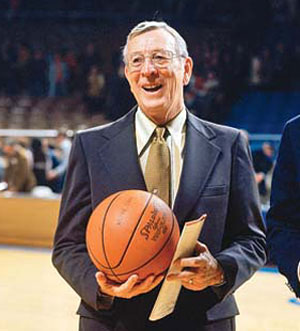
Same thing happened in NCAA Division 1 men's basketball...which, from the 1963-64 campaign to the 1974-75 season, was in the grip of one team: John Wooden's UCLA Bruins.
The Bruins took ten of the twelve D-1 men's titles offered during that span of time. It would've been twelve straight if Texas Western hadn't stopped Kentucky, 72-65, to end the 1965-66 season- a season where Oregon State interrupted UCLA's reign in the old AAWU (now, of course, called the Pac-12); and if, in 1973-74, North Carolina State hadn't beaten Marquette, 76-64...after the Wolfpack dethroned the Bruins, 80-77, a couple of days earlier.
By the way...a year after their school won it all in men's hoops, Texas Western College of the University of Texas officials changed their institution's name to the University of Texas at El Paso.
Wooden showed that he could get UCLA to the top with any kind of team, be it a run-and-gun kind, a patient team, or one headlined by a certain 7-2 center who, while still in high school, had college recruiters all over the country knocking each other over to sign him.
Lots of other head men's hoops coaches breathed heavy, heavy sighs of relief when John decided to hang up his whistle after the 1974-75 season...a campaign that ended when UCLA thwarted Kentucky, 92-85.
That's how the 37th NCAA D-1 men's hoops tourney ended. Before the Blue and Gold seized control of men's D-1 roundball, 18 different squads had won the first 25 NCAA D-1 men's basketball tournaments, starting with Oregon (the 1938-39 kingpin). And Kentucky was the sport's gold standard, with four championships- 1947-48, 1948-49, 1950-51, and 1957-58.
By the time the 1974-75 season ended, 21 teams had won the 37 NCAA D-1 men's b-ball tourneys. Since then, 14 others had taken the pot of gold for the first time ever.
And men's college basketball has grown exponentially in popularity since then...to the point where the gender's D-1 Big Dance is the NCAA's most lucrative event. (An event where this country's president fills out a bracket every March, just like millions of other Americans.)
While the 78th NCAA D-1 men's hoops tournament is going on, the 35th NCAA D-1 women's basketball tourney is also happening.
And, as Geno will tell you, it's all taking place at a time similar to what was happening in men's Division 1 ball during the 1963-64/1974-75 era.
Connecticut's first D-1 women's title came at the end of the 1994-95 season. Before that, eight different clubs claimed the first 13 NCAA Division 1 women's basketball tournaments, with Tennessee leading the way (the Volunteers, then under Pat Summitt, were tops in 1986-87, 1988-89, and 1990-91).
Since UConn got that first notch, teams headed up by Auriemma and Summitt nailed down 14 of the next 20 titles in D-1 women's roundball...with Tennessee grabbing three championships in a row from 1995-96 to 1997-98,
then triumphing in 2006-07 (the act that angered Rutgers fan Don Imus) and 2007-08.
Five other teams accounted for the other six championships of the 1995-96/2014-15 period- Purdue (in 1998-99), Notre Dame (whose 2000-01 title prevented what ultimately could've been a UConn five-peat), Baylor (the only one able to go for seconds; the Bears followed up their 2004-05 championship by ruling in 2011-12), Maryland (the winner in 2005-06), and Texas A&M (which took it all in 2010-11).
So, that's it...coming into March Madness 2016, 14 different squads have won the first 34 NCAA D-1 women's b-ball tournaments.
At this very moment, the Huskies are working on a four-peat.
But first, they'll have to take the Longhorns out of the way tomorrow night to win the East Regional.
Two more victories after that, and Auriemma will get his eleventh title as a head coach...and he'll pass Wooden in the process.
The way I see it, Connecticut's success (that's putting it mildly) in D-1 women's basketball isn't killing the sport.
Media apathy toward the game is.
I mean, it hurts to turn on one of Disney's ESPN networks each March and find a good, good game being played in front of...rows and rows of empty seats.
It hurts, too, that these same media people- even those at Disney- don't lavish the same attention on women's ball as they do on men's ball. The scrolls themselves offer a clue: Rarely this season were you told how many points Stewart had in this or that game. (By contrast, Georges Niang's name was almost always seen in the scrolls here in 2015-16.)
Listen...Iowa State's Niang and Connecticut's Stewart were two of college basketball's leading players these last four seasons. Let's give 'em BOTH shout-outs!
And that speaks to something else.
How committed are many of the NCAA's Division 1 schools to their women's basketball teams?
Not just in money...but in spirit.
It's been 44 years now since Title 9 became law...and it hurts that, 44 years later, lots of resentment continues to exist over the law. The resentment not only shows up on TV and on sports radio, but in no telling how many athletic departments at no telling how many schools here in America.
How much support do the Breanna Stewarts really have, given- let's face it- America's anti-female heritage?
Breanna herself had one real answer to giving women's NCAA basketball a boost:
"Teams need to get better, players need to get better, and that starts from before we even get to college."
John Wooden had no problem with women's college basketball. He, in fact, called it a purer form of the sport than the men's kind.
I've always thought athletes were athletes, regardless of gender.
How about you?
Sunday, March 27, 2016
Killing the Game?
Labels:
apathy,
basketball,
Breanna Stewart,
Bruins,
championship,
college,
Connecticut,
domination,
Geno Auriemma,
Huskies,
John Wooden,
March Madness,
media,
NCAA,
sports,
tournament,
UCLA
Saturday, February 27, 2016
The Powerhouse from Alabaster, Alabama (Part 3)
Wendy Holcombe's effort to become an all-around entertainer hit a couple of huge bumps in 1981-82.
First of all, in the summer of 1981, the pilot the Alabaster, AL native did for NBC, the sitcom Wendy Hooper, US Army, didn't get picked up (America's TV viewers hitched their wagons to another Army-based comedy, CBS' Private Benjamin, which presented Lorna Patterson in the role made famous by Goldie Hawn in the previous year's big-screen hit of that name).
Had Wendy Hooper caught on, Holcombe (then 18 years old) would've been one of the youngest to ever get top billing on a prime-time sitcom on American television. (Jay North was just seven in 1959, the year he landed the show that gave him his fame: Dennis the Menace.)
Bill's and Helen's multiinstrumentalist-singer-comic daughter got a sitcom anyway when, on 10-29-1981, Lewis & Clark premiered on NBC.
The same viewers who kept WHUSA from joining the Peacock Network's 1981-82 schedule stayed with L&C's biggest Thursday-night competition, CBS' Magnum, P.I. (That crime drama- the one that made a household name out of Tom Selleck- survived its rookie campaign, the 1980-81 season.)
Not even a pair of time-slot changes could save Lewis & Clark, where Holcombe played a server (okay, waitress) in the Luckenback, TX nightclub run by Gabe Kaplan and Guich Koock.
Even if many people couldn't get into Wendy Holcombe the actor, they still fell head over heels in love with Wendy Holcombe the musician. And some extra proof of that came in 1983, when Wendy, her hubby Tom Blosser, and their band traveled to Israel to play alongside bluegrass legends Bill Monroe and Mac Wiseman.
Not long after that, Tom and Wendy turned their 1983 travels into a world tour, focusing on Australia, New Zealand, and several Asian countries.
The closing act on that international tour: None other than Perry Como.
Meanwhile, back in the United States, the banjo-playing wife and her bass-playing husband set up shop in Florida, only to move to North Carolina...to get closer to relatives.
And a year or so before WLH and TYB set out for their overseas tour, Wendy Lou started performing alongside fellow banjoist Buck Trent.
Their performances set that twosome up for a 1982 Music City News Bluegrass Act of the Year award nomination. Later on, the Country Music Association nominated them for Instrumentalists of the Year.
All this time, Wendy was performing despite a degenerative heart condition (first diagnosed at an early age).
By the middle 1980s, that heart condition (technically known as cardiomyopathy; in lay terms, enlargement of the heart) wasn't improving.
Several times, an ambulance would arrive at the Holcombe-Blosser house to pick Wendy up...but she'd beat the odds whenever they were stacked against her recovery.
Then came that ill-fated Saturday...the seventh Saturday of 1987.
Country music's much the poorer because of Wendy's 2-14-1987 death. The Alabaster Kid strove for perfection in everything she did...including in her musical endeavors. And that pursuit of perfection showed whenever she appeared in front of any kind of live audience or whenever Wendy appeared in front of a set of TV cameras.
Even if you and I can't go online and find Holcombe's acting performances (you'll strike out on www.youtube.com if you're looking for Lewis & Clark episodes), there's plenty of audio evidence (the posthumously-released CD "Memories of Wendy" is finally available...on www.cdbaby.com as well as www.amazon.com) and plenty of video evidence right here on the Internet that Cindy's and "Muley's" sister was a powerful musician.
And a powerful, energetic, enthusiastic influence.
Wendy, I'm glad you came along...and I'm glad you brought so many great things.
Monday, February 22, 2016
The Powerhouse from Alabaster, Alabama (Part 2)
It was 1980, and Nashville on the Road's Wendy Holcombe was knockin' 'em dead...not only on that syndicated TV show, but also as a guest on other series (as well as that 1979 ABC special, "Merry Christmas from the Grand Ole Opry," cohosted by WKRP in Cincinnati's Loni Anderson and Vega$' Bob Urich).
And then there were the personal appearances the Alabaster Kid made, where audiences got a chance- up close and personal- to check out her infectious brand of banjo pickin', fiddlin', guitar playing, and vocalizing.
One thing was still missing: A recording contract with a major or not-so-major label.
All Wendy's NOTR partners were cutting sides. I mean, Jim Ed Brown was still recording for RCA (he was heading for 25 years with the label...going back to when Jim Ed and his sisters Maxine and Bonnie were a trio, the Browns). Helen Cornelius joined RCA in 1976 and immediately teamed up with Jim Ed; the next year (same one in which the label's biggest star passed away at age 42), Helen became a regular on Nashville on the Road.
Jerry Clower's comedy albums (on MCA) were selling pretty well, too.
But you still couldn't go to your favorite record store and pick up Holcombe's latest LP/8-track cartridge/cassette.
There was no such thing (unless you were into bootlegging).
But you could still watch WLH on TV...not only on NOTR,
but also on shows like Hee Haw.
About the time Wendy started doing guest shots on Roy Clark's and Buck Owens' biggest gig, she met a bass player named Thomas Yoshiro Blosser (he turned 29 in 1980). Not long after that initial Hee Haw taping, Tom started playing bass in Wendy's band.
Tom already had a pedigree in country music, backing up some of the music's biggest names (such as Louise Mandrell).
TYB (born Yoshiro Sudo) came into the world 11-3-1951 in Muroran, Japan; in 1957, a Mennonite missionary couple named Eugene and Louella Blosser adopted him...and changed the little boy's name.
In Muroran, Tom had a biological brother and a biological sister...and they were all raised by their grandmother once the children's parents passed out of the picture.
Toward the end of '57, Louella and Eugene (whose biological children were Philip and Rachel), living and parenting- to say nothing of doing missionary work- in Japan at the time, got the chance to add another child to their family (a prospect that lighted little Philip's fire).
Enter Yoshiro/Tom.
And he and Phil hit it off immediately.
By 1959, the Blossers of Sapporo started making regular trips to the United States...and on one of those, Thomas became a naturalized American citizen.
Back in Japan, Phil and Tom eventually attended middle school in Sapporo before going on to high school in Tokyo.
In Tokyo, they found out that Tom had chops- he could play a mean guitar. In fact, he and his older adopted brother finished off a talent show at the high school by singing "Mrs. Robinson."
The fundamentalists in the audience weren't looking for that.
Phil and Tom next went to college...here in the US. Tom chose a two-year institution, Hesston College (in Hesston, KS).
It didn't really work out.
TYB's heart was in music, and he spent most of the 1970s playing guitar and bass (mostly bass) in all sorts of bands- rock, R&B, and country.
It all stood him in good stead by the time he and Wendy got together.
And it wasn't long before Blosser's and Holcombe's musical relationship became a marital one, too.
But first...Wendy had a chance to fulfill her dream of becoming a complete entertainer.
In 1981, NBC offered Cindy's and "Muley's" sister her own TV series: Wendy Hooper, US Army. It was all about an outgoing, banjo-playing girl who thought that joining the Army would advance her country-music career.
The pilot episode aired on Friday, 8-14-1981. (I had a chance to watch it...and I didn't think Wendy Hooper was too bad.)
The show's other viewers and I were badly outnumbered. After all, the WHUSA pilot came on four months and eight days after CBS turned Goldie Hawn's 1980 romp, "Private Benjamin," into a full-fledged series.
With Lorna Patterson (you might remember her from another 1980 movie, "Airplane!") taking over from Hawn, most of America's TV viewers didn't feel like supporting two prime-time sitcoms about young women coming in from left field to join the branch that gave Dwight Eisenhower and Colin Powell their first tastes of fame.
And besides, "Airplane!" showed that Patterson could sing and play the guitar, too.
Peacock Network potentates weren't done trying to turn Wendy Lou Holcombe into an actor. Her next acting try, Lewis & Clark, made it into the 1981-82 NBC schedule.
Lewis & Clark (it debuted 10-29-1981) was Gabe Kaplan's followup to Welcome Back, Kotter and the series Guich Koock did after Carter Country. In addition, the show featured a pre-Mr. Belvedere Ilene Graff (as Kaplan's wife) and an Amy Linker who, as things turned out, was one season away from teaming up with Sarah Jessica Parker on the critically-acclaimed Square Pegs.
And David Hollander (he, too, from "Airplane!") was along to play Linker's brother.
Anyway, Kaplan played a native New Yorker who wanted to open up a country-music nightclub...but not in the Big Apple.
The club was going to be in Luckenback, TX...away from Fun City's hustle and bustle.
Well, the nitery was called the Nassau County Cafe. And Koock played its manager, while Holcombe was its sole server (okay, waitress).
Despite a shift from Thursday nights to Saturday nights (and then one to Friday nights), L&C never caught on...probably because viewers thought Gabe needed better "Sweathogs" than Wendy, Guich, Clifton James (the show's town drunk), and Michael McManus (the bartender).
To top it off, Julie Kotter (played by Marcia Strassman) never had kids!
So it was back to playing and singing country and bluegrass for Wendy Holcombe...with her new hubby, Thomas Blosser, by her side on bass.
When we come back, we'll look at how Wendy's last years turned out.
Saturday, February 20, 2016
The Powerhouse from Alabaster, Alabama (Part 1)
For the last week and a half, I'd been thinking about a young performer who was a regular on a syndicated TV series called Nashville on the Road. She was a regular on this country music show from its debut in 1975 to 1981 (NOTR limped along for another two years afterwards).
At first, the show's cohosts were singer Jim Ed Brown and comic Jerry Clower; every week, they'd introduce a guest or two (as well as the show's two regular acts).
That's right...I like almost all forms of music, and that includes country.
One late Saturday night in 1976, I was flipping channels...and ran into Nashville on the Road, which, at that time, was locally (the Des Moines/Ames area) on WOI-TV, the Des Moines/Ames area's ABC station.
I noticed this thirteen-year-old girl who was picking a mean, mean banjo and moving along to her own (and her bandmates') beat.
She hooked me...and things got to the point where, every Saturday night at 10:30 PM (Central time), I'd flip the station over to "ABC5" and check out Jim Ed, Jerry, the Cates Sisters (their successors, the Fairchilds, were replaced in 1977 by singer Helen Cornelius), and that young instrumentalist-singer-comic.
Instead of getting ready to blow out 53 candles this coming 4-19-2016, Wendy Lou Holcombe passed away on 2-14-1987.
At age 23.
Of a heart attack.
At the time Wendy died, I was into my first stint of living here in Omaha...and working two jobs (I was an inventory specialist and a pizza-delivery driver at this time in 1987). I was coming back from my job at Domino's (that's right, THAT Domino's) when I turned on my TV, started flipping through channels, and I stopped at The Nashville Network...the forerunner of today's Spike.
When the news came on about the death of the most famous performer to ever come out of Alabaster, AL, I was completely flabbergasted.
Wendy Holcombe- that total bundle of energy- dead? At 23? Of heart failure? How'd that happen?
Then I got to thinking about the fact that not one single sizable recording company offered her a contract.
What stopped the record industry's Billy Sherrills, Owen Bradleys, and Chet Atkinses from having Holcombe sign her John Hancock to a recording contract? If not age, what?
I still, to this very day, feel it all came down to dirty rotten, filthy sexism.
I mean, at a time when Dolly Parton, Barbara Mandrell, and Roni Stoneman (she of Hee Haw fame) were showing what they could do with five strings, the thinking in corporate boardrooms was (and, in too many cases, still is) that a banjo is a man's instrument. After all, Uncle Dave Macon, Grandpa Jones, and Earl Scruggs led the way. (Oops...I should've mentioned Earl first!)
A man's instrument.
That was the way it was supposed to work out in the house where Bill and Helen Holcombe were raising their three children when, sometime in 1974, Bill brought a used banjo home (it even came with an instruction booklet and an instruction record).
Bill struggled for two months to be the next Roy Clark or, well, Earl Scruggs...but, in the end, he couldn't even get one tune down. Wendy begged for the chance to see what she could do with that banjo, only to get turned down by her father: "This banjo is too expensive for you to fool around with."
Wendy found an ally in her mother.
Helen let the then eleven-year-old pick around with Bill's pride-and-joy while Bill was off at his nine-to-five. By the time that afternoon session came to end, Wendy mastered "Mountain Dew" and other numbers her dad tried to learn.
And when Bill came home from his job, he was so impressed with Wendy's version of "Dew" that he let her keep the same banjo he'd struggled with.
Helen's and Bill's little daughter practiced on that banjo day and night; she'd take it out to the Holcombes' barn and try her music out on her cows, goats, and horses.
It paid off, because Wendy went on to win $50 at a county fair talent show...and that led to her going to nearby Birmingham to appear on TV's The Country Boy Eddie Show.
WLH's big break was just up the road...Interstate 65, that is.
After seven months of pickin', Wendy wanted to go to Nashville's Grand Ole Opry to celebrate her twelfth birthday.
Bill and Wendy couldn't get tickets (you needed- and still need- to get those ducats in advance), so father and daughter decided to hang around Music City for a few hours. At the first music shop they ran into, WLH saw a snazzy-looking banjo and asked for permission to test it out.
Holcombe's version of "Foggy Mountain Breakdown" attracted the bass player in Stoneman's band. He then took the young picker and her dad to a nightclub, where she played a few songs onstage...while "Billy Jack" met a promoter who said he could get the Two Holcombes backstage at Opryland.
That's where Wendy Holcombe met Roy Acuff.
Next thing she knew, she ended up backstage playing alongside his Smoky Mountain Boys, Jones, and several other Opry regulars. And that led to an appearance the next night at the "Midnight Jamboree" at Ernest Tubb's Record Shop.
And that spawned appearances on two other TV shows: The Porter Wagoner Show and Pop! Goes the Country.
And then...and then...in the fall of '75: NOTR, put out by the same production company that came up with Pop! Goes the Country.
Because of Nashville on the Road, Wendy Lou closed out 1975 by fulfilling her lifelong wish.
She performed at the Grand Ole Opry.
On the main stage this time.
And what's more, Wendy Lou worked alongside Jim Ed at the Opry that night.
With Nashville on the Road becoming a hit, things continued to look up for "Muley's" and Cindy's kid sister, who went on to master the fiddle, the guitar, the mandolin, and the dobro...and topped that off by playing trumpet in her school's band back in Alabaster.
All of that from a teenager who, at first, took piano lessons.
And as the 1970s started to morph into the 1980s, Wendy wanted to become a total entertainer. (She wanted to try acting...and in the process, follow Johnny Cash.)
Non-NOTR TV appearances began to mount up for the Alabaster Kid; they included turns on shows like Big Blue Marble, The Mike Douglas Show, and The New Mickey Mouse Club. And in 1979, she appeared on a Christmas special on ABC; the show was hosted by none other than Loni Anderson, of WKRP in Cincinnati fame; and Robert Urich, who was knocking 'em dead on that network's (ABC's) Vega$.
Well, a guest shot on Hee Haw took Wendy's life in another direction...and we're going to look at that direction when we come back.
SHOUT-OUT TIME: A lot of this information came from an excellent Website, www.wendyholcombe.com. (Check it out whenever you get a chance!)
Sunday, January 31, 2016
No Repeat...No Repeat
As things turned out with this "shoulda/coulda/woulda" version of the 2015 NCAA Division 1-A football playoffs, it all came down to two teams looking for a second playoff championship...one of them going after a second consecutive title in this version of a big-school playoff.
Time to just cut to the chase and show you just what happened:
FIRST ROUND (seeding in parentheses): Western Kentucky (9) 38, Arkansas State (24) 6; TCU (16) 28, Appalachian State (17) 14; Florida State (13) 14, Florida (20) 10; Northwestern (12) 10, Temple (21) 0; Oklahoma State (14) 63, Bowling Green State (19) 42; Notre Dame (11) 21, San Diego State (22) 7; Navy (15) 24, Toledo (18) 0; North Carolina (10) 21, Michigan (23) 3
SECOND ROUND: Clemson (1) 35, Western Kentucky 31; Stanford (8) 35, TCU 21; Florida State 22, Houston (5) 21; Iowa (4) 21, Northwestern 7; Oklahoma (6) 42, Oklahoma State 28; Michigan State (3) 14, Notre Dame 0; Ohio State (7) 21, Navy 7; Alabama (2) 28, North Carolina 0
QUARTERFINAL ROUND: Clemson 19, Stanford 14; Iowa 21, Florida State 14; Oklahoma 28, Michigan State 7; Alabama 21, Ohio State 7
SEMIFINAL ROUND: Iowa 20, Clemson 14; Alabama 24, Oklahoma 7
CHAMPIONSHIP GAME: Iowa 14, Alabama 7 (1 OT)
Now...it's time for some highlights!
FIRST ROUND: Brandon Doughty completed 30 of 37 passes for 357 and four TDs to key the Hilltoppers (favorite target Taywan Taylor caught six balls for 134 yards and two TDs)...Trevone Boykin's 80-yard scoring toss to Kolby Listenbee 3:17 into the game set the tone for the Horned Frogs...Wildcats outgained Owls, 268-256...Gators couldn't capitalize on their two first-quarter safeties (for a 4-0 lead), and went on to be held to 186 total yards (25 of 'em on the ground in 36 tries) while Seminoles' Dalvin Cook scampered for 125 yards in 23 trips (scored a TD, too)...Fighting Irish outgained Aztecs, 463-207 and held the Mountain West kingpins to just 40 passing yards (on 3-for-17 throwing)...Keenan Reynolds (26-134 with a pair of scores) led a Midshipmen attack that got 323 rushing yards in 69 totes...Cowboys outgained Falcons in a barnburner in Stillwater, 590-560; OSU's Mason Rudolph (29-42-523-6 TDs-1 INT)
and BGSU's Matt Johnson (31-57-521-% TDs-1 INT) put on quite a show, while winners' James Washington snared three scoring tosses in a four-catch, 154-yard showing- to waste Roger Lewis' six-catch, 210-yard, two-TD effort for Bowling Green State...Wolverines got more yards than Tar Heels, 399-358, but lost because they committed 13 penalties for 71 yards.
SECOND ROUND: Cougars coughed up a 21-7 lead, then with 41 ticks to go in regulation, couldn't stop Cook from scoring the winning two-point conversion (after Seminoles' Everett Golson fired a three-yard scoring strike to Ermon Lane)...J.T. Barrett's 80-yard TD run on the first play of the game set things up for the Buckeyes...Wildcats' Solomon Vault took the opening kickoff back 100 yards for the game's first score, but all it did was lead to 21 unanswered Hawkeye points in a rematch of a regular-season game...in another rematch, Baker Mayfield matched Rudolph in touchdown throws (four)- but the Sooners picked off three Rudolph aerials...Irish outgained Spartans, 419-310 (with C.J. Prosise getting 138 yards in 16 rushes), but just couldn't find the end zone...Christian McCaffrey's 225 all-purpose yards (134 on the ground, 41 on catches, and 50 on returns) helped Cardinal sideline Frogs in a game where TCU once led, 14-7...Derrick Henry put on a 26-144-3 TD show
as Crimson Tide held Tar Heels to 52 ground yards...Wayne Gallman's one-yard scoring run with 1:17 to play in fourth quarter saved Tigers' bacon (and made Deshaun Watson's 368 total yards- 216 by air, 152 by land- stand up).
QUARTERFINAL ROUND: Cook still got his yards (18-134-1 TD), but Derrick Mitchell scored from four yards out with 8:38 to play in the fourth stanza to lift the Hawkeyes (Iowa had trailed, 14-7)...Sooners erased a 7-7 tie by reeling off 21 unanswered points...Tide and Buckeyes got involved in a bitter, sloppy game marked by 23 penalties (13 by Ohio State, 10 by Alabama); Heisman winner Henry outrushed the Bucks, 103-94- and scored twice...Tigers won it on C.J. Fuller's five-yard run with 1:40 to go in regulation; what's more, Clemson limited McCaffrey to 34 yards in 19 attempts.
SEMIFINAL ROUND:
Playoff MVP Desmond King swiped four Watson passes and helped Hawkeyes force him into a 13-for-27-for 165 yards outing (and helped thwart Tigers' furious fourth-quarter rally)...Henry scored twice in a 27-121 effort that drew 102,354 to Bryant-Denny Stadium.
CHAMPIONSHIP GAME: At University of Phoenix Stadium in Glendale, AZ, Henry was held to 99 yards in 22 carries. On top of that, Hawkeyes outgained Tide, 264-263...with the difference coming from Jordan Canzeri's game-winning TD with 12:52 to play in overtime.
With that, instead of Alabama getting its second straight D-1-A playoff championship, Iowa gained its second playoff title- and first since 2002.
Another thing Kirk Ferentz' team did by retaking the top was end a four-year period in which a team that had never won these Division 1-A playoffs before triumphed.
Who knows how the 2016 Division 1-A football playoffs (at least this version) will shape up? Stay tuned!
Sunday, December 27, 2015
Well, Three Out of Four Ain't Bad
This is the post I've been waiting two weeks to write.
I'm still conducting a 24-team NCAA Division 1-A football playoff, and I can't wait to finally get cracking on it. Finally got time that I can spend actually playing the games.
Really excited about the 2015 field, because it's got four teams that've never participated in this version of a playoff before, one finally back in the field for the first time since Ronald Reagan was calling the shots at 1600 Pennsylvania Avenue, two others making their first appearance each since Bill Clinton was giving Oval Office speeches, and...well, here's what the 2015 field looks like:
1. Clemson (13-0; ACC champ)/2. Alabama (12-1; SEC champ)/3. Michigan State (12-1; Big Ten champ)/4. Iowa (12-1; Big Ten at-large)/5. Houston (12-1; AAC champ)/6. Oklahoma (11-1; Big 12 champ)/7. Ohio State (11-1; Big Ten at-large)/8. Stanford (11-2; Pac-12 champ)
9. Western Kentucky (11-2; C-USA champ)/10. North Carolina (11-2; ACC at-large)/11. Notre Dame (10-2; independent at-large)/12. Northwestern (10-2; Big Ten at-large)/13. Florida State (10-2; ACC at-large)/14. Oklahoma State (10-2; Big 12 at-large)/15. Navy (10-2; AAC at-large)/16. TCU (10-2; Big 12 at large)
17. Appalachian State (10-2; Sun Belt at-large)/18. Toledo (9-2; MAC at-large)/19. Bowling Green State (10-3; MAC champ)/20. Florida (10-3; SEC at-large)/21. Temple (10-3; AAC at-large)/22. San Diego State (10-3; Mountain West champ)/23. Michigan (9-3; Big Ten at-large)/24. Arkansas State (9-3; Sun Belt champ)
Using a system akin to what your state's high school athletic association uses in order to determine football playoff seeding, I got results that agree with the College Football Playoff selection committee...in the top three spots.
Had the Big 12 had two more members, it could go back to playing a football title game. And the lack of such a sports event costs that conference's champion 50 extra quality points every year.
Speaking of quality points...Houston and Iowa had the same number of them (500) this time around. But the Hawkeyes (making their first D-1-A playoff appearance in six years) got the nod over the Cougars (back for the first time since losing to Oregon in the 2011 title game) because Iowa's Division 1-A opponents won 69 games to 67 for the 1-A squads Houston had to fight.
Northwestern, Florida State, and Oklahoma State totaled the same number of quality points as well- 365. The Seminoles got a higher seed than the Cowboys on account of FSU's 1-A foes winning 69 games themselves in 2015 while the 1-A teams that played O-State racked up 68 wins. (One of the Cowboys' foes was Kansas...which limped home without a win this season.)
Still, the Wildcats topped the Cowpokes and 'Noles because their own Division 1-A opponents won 75 times, enhancing Northwestern's first time in these playoffs since 1995 (when the 'Cats lost in the semifinals to future Big Ten foe Nebraska).
It's also North Carolina's first time in this set of playoffs since 1997 (when the Tar Heels lost in the first round to Ohio State). San Diego State, meanwhile, had been waiting since 1986 to get back to the playoffs. (The Aztecs went out in the first round, too, losing to Texas A&M.)
To top it all off, it's time to congratulate Appalachian State, Navy, Temple, and Western Kentucky for making it into these 1-A playoffs for the first time each.
Can't wait to see how these teams do. I'll be using Lance Haffner Games' old 3-in-1 Football, and playing the games computer vs. computer. And when all the results are in, I'll be glad to let you know.
I'm Jim Boston, and thanks for reading this blog!
Tuesday, December 15, 2015
Well, It Happened
The eye operation I was scheduled to undergo, that is.
It wasn't the cataract surgery I'd written about earlier. (Last month, I was told by the ophthalmologist scheduled to do what turned out to be yesterday's surgery that putting me through cataract surgery at this present time might mean losing my eyesight.)
Yesterday's operation had to do with repairing the retina in my left eye.
A couple of months ago, when I made my first visit to Midwest Eye Care in eleven years, I was told that a retinal rip had been found in that left eye (as well as the cataract in said peeper).
So yesterday, at 9:30 AM (Central time), Dr. David Ingvoldstad (the O.D. I met last month) and one of the clinic's nurses, Sarah Plagman (Sarah, I hope I got your last name right!), went to work on that offending eyeball of mine.
First of all, I received six drops of dilating fluid (Sarah was hoping that just three would turn the trick); then, when the left eye proved it was lubricated enough, a numbing fluid was added.
Then David put a new lens into my left eye. And after that (with Sarah holding my head so that my chin would stay on the bar), he administered four laser blasts to that left eye.
The whole thing was completed by 10:00 AM.
And something I'd agonized about for almost two weeks turned out to be fine.
I was pleasantly surprised to find out that they didn't have to stick a patch over the affected eye once the operation ended. (The patch would've gone on if a local anesthetic had been applied around that left eye.) What's more, I was told that I could immediately go back to my pre-surgery activities...like reading, watching TV, computer work, etc., etc.
After yesterday's argon retina laser operation, my left eye feels a bit better...for now.
The final verdict is yet to come, for it usually takes a month or so before argon patients can tell the difference in their eyesight. (I'm still worried about the halo effect in my left eye.)
Well, for me, the next test comes on 1-18-2016, when I come back to the Midwest Eye Care office at 4353 Dodge St. here in Omaha.
Here's hoping yesterday's operation turns out to be a complete success.
Labels:
argon,
eye,
health,
laser,
Midwest Eye Care,
Nebraska,
nurse,
Omaha,
operation,
ophthalmologist,
procedure,
retina,
surgery,
vision
Subscribe to:
Posts (Atom)